
Digital Health Industry News and Market Data: Global Market Forecast to Grow at 13.1% CAGR as Software, Mobile Health and Connected Care Reshape Healthcare Delivery
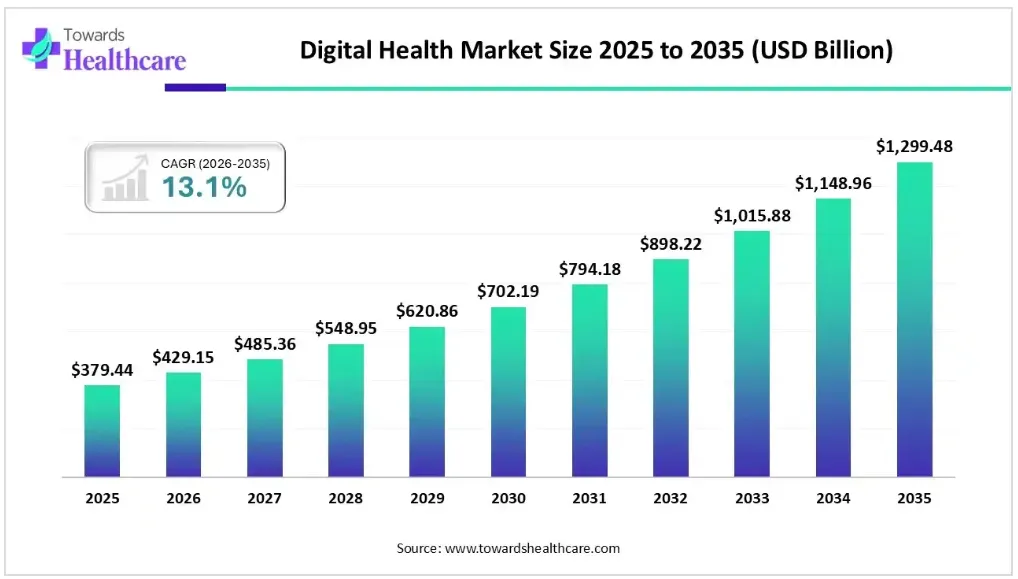
Ottawa, Oct. 21, 2026 (GLOBE NEWSWIRE) -- The global digital health market is entering a new phase of growth as healthcare providers, technology companies, insurers, and life sciences organizations shift from isolated digital tools toward integrated, AI-enabled healthcare platforms. According to Towards Healthcare (a sister firm of Precedence Research), the market is projected to expand from USD 379.44 billion in 2025 to USD 429.15 billion in 2026 and reach USD 1,299.48 billion by 2035, registering a compound annual growth rate (CAGR) of 13.1% from 2026 to 2035.
Download a sample of the Digital Health Market report to explore market forecasts, segment analysis, regional opportunities, and competitive insights: https://www.towardshealthcare.com/download-sample/5040
The market outlook coincides with a changing investment environment. Digital health funding is increasingly concentrated in companies with established commercial traction, enterprise customers, and technologies that demonstrate measurable clinical or operational value. Mergers and acquisitions are also accelerating as technology providers seek capabilities in artificial intelligence (AI), clinical workflow automation, healthcare data integration, and revenue-cycle management.
For decision-makers, the central question is no longer whether healthcare will adopt digital technologies. It is which technologies, business models, geographies, and providers will capture sustainable value as healthcare organizations prioritize measurable outcomes, interoperability, cybersecurity, and financial performance.
Market Data Snapshot
| Market Indicator | Data | Business Implication | |
| Global market size, 2025 | USD 379.44 billion | Establishes a substantial commercial base across digital healthcare technologies and services | |
| Global market size, 2026 | USD 429.15 billion | Indicates continued expansion in digital healthcare spending | |
| Projected market size, 2035 | USD 1,299.48 billion | Creates long-term opportunities for software providers, connected-device manufacturers, and healthcare technology investors | |
| Forecast CAGR, 2026–2035 | 13.1 | % | Supports strategic investment in scalable digital health solutions |
| U.S. market, 2025 | USD 88.38 billion | Highlights the importance of the U.S. for commercialization and enterprise technology sales | |
| Leading region | Europe | Signals an established market for digital healthcare infrastructure and integrated care | |
| Fastest-growing region | Asia Pacific | Creates opportunities for localized platforms, mobile health, and digital access solutions | |
| Leading technology segment | Telehealth | Reflects established demand for virtual care and remote healthcare delivery | |
| Fast-growing technology segment | Mobile health (mHealth) | Supports investment in smartphone-based care, patient engagement, and connected monitoring | |
| Leading component | Services | Demonstrates the continuing importance of implementation, integration, support, and managed services | |
| Fast-growing component | Software | Highlights opportunities in AI-enabled workflows, analytics, and interoperable platforms | |
Market estimates and segment positioning are based on Towards Healthcare's Digital Health Market research.
Schedule a Meeting: Schedule a meeting with our expert team to discuss your digital health market research requirements, competitive intelligence needs, and growth opportunities. https://www.towardshealthcare.com/schedule-meeting
What the Latest Data Shows
The increase from USD 379.44 billion in 2025 to USD 429.15 billion in 2026 represents approximately 13.1% year-on-year growth. By 2035, the projected USD 1.30 trillion market would be more than three times its 2025 value.
This expansion reflects the convergence of several spending priorities: digital patient access, electronic health records, virtual consultations, connected medical devices, clinical decision support, health data analytics, and workflow automation. However, the market's breadth means companies must distinguish between overall sector growth and the addressable opportunity for their particular product or service.
A telehealth provider, for example, competes on access, clinician availability, patient experience, and reimbursement. An enterprise software vendor must demonstrate interoperability, cybersecurity, implementation reliability, and integration with existing hospital systems. A remote-monitoring company needs evidence that its devices and analytics can support clinical workflows and deliver sufficient value to justify recurring expenditure.
The commercial implication is that digital health market intelligence must connect market forecasts with actual buying behavior, product capabilities, procurement priorities, and competitive positioning.
Investment is recovering, but capital is becoming more selective
Global digital health funding reached approximately USD 22.6 billion in the first half of 2026, compared with USD 21.4 billion in the first half of 2025. Yet the number of funding rounds declined from 975 to 608, indicating that a similar overall pool of capital was distributed across fewer transactions.
The average deal size reached approximately USD 48.9 million, while disclosed mergers and acquisitions accounted for USD 5.15 billion across 82 transactions in the same half-year period.
These indicators suggest that investors are placing greater emphasis on companies with defensible technology, credible commercial adoption, recurring revenue potential, and the ability to scale across healthcare systems. Early-stage companies may face greater pressure to demonstrate clinical validation, customer retention, and a clear route to reimbursement or enterprise procurement.
For investors and corporate development teams, the opportunity lies in identifying which digital health categories are attracting capital, where valuations are being supported by commercial evidence, and which capabilities can be acquired more efficiently than developed internally.
Access the Dashboard: Access the Towards Healthcare dashboard to explore market data, company intelligence, segment trends, and competitive developments. https://www.towardshealthcare.com/access-dashboard
Key Market Trends and Developments
1. Healthcare AI is moving toward enterprise deployment
AI is increasingly being integrated into clinical documentation, medical imaging, patient triage, administrative workflows, decision support, drug discovery, and healthcare analytics. The commercial opportunity extends beyond stand-alone AI applications to infrastructure that embeds intelligence into existing clinical and operational systems.
In the first quarter of 2026, digital health investment reached USD 7.4 billion, up from USD 5.9 billion in the preceding quarter. Funding was concentrated in large transactions: 19 mega-rounds of at least USD 100 million accounted for 60% of funding during the quarter.
Healthcare AI companies attracting strategic attention include platforms supporting clinical documentation, administrative automation, diagnostics, and research workflows. Pharmaceutical companies are also investing in AI-enabled drug discovery, creating overlap between digital health, biotechnology, and life sciences technology markets.
Business implication: Vendors should evaluate clinical evidence, workflow integration, deployment economics, data access, and buyer readiness not simply the presence of AI features. Market entrants need to understand which applications have moved beyond pilots and which remain dependent on validation or uncertain reimbursement.
2. Digital health mergers and acquisitions are accelerating
Digital health consolidation is becoming a route to scale, product diversification, and access to established customers. During the first half of 2026, 115 digital health acquisitions were reported, with the second quarter accounting for 71 transactions.
Healthcare technology buyers are seeking complementary products, AI capabilities, enterprise relationships, and regional expertise. The acquisition environment also creates opportunities for investors looking to combine smaller solutions into broader platforms.
Accenture's acquisition of Alfahealth, which closed on October 8, 2026, strengthens its digital health capabilities in Italy. The transaction adds a service-led platform designed to help healthcare organizations modernize clinical processes, connect data across the care continuum, and improve patient access.
For corporate development teams, this highlights the strategic value of local implementation expertise and integrated healthcare workflows. Acquisition targets should be evaluated against customer concentration, technology compatibility, regulatory exposure, recurring revenue, and expansion potential.
3. Interoperability is becoming a commercial differentiator
Healthcare organizations frequently operate multiple electronic health record systems, patient engagement tools, imaging platforms, billing applications, and remote-monitoring technologies. Disconnected systems can increase administrative costs and make patient information harder to use across care settings.
In the United States, federal interoperability and prior-authorization requirements are influencing technology procurement. A major implementation milestone under the CMS interoperability framework is scheduled for January 2027, increasing pressure on affected payers and technology vendors to prepare their systems and workflows.
Platforms capable of integrating clinical data, automating authorization processes, and supporting standardized data exchange may therefore benefit from stronger enterprise demand.
Business implication: Digital health vendors should monitor regulatory implementation timelines, healthcare IT procurement cycles, interoperability standards, and partnership announcements to identify near-term sales opportunities.
4. Mobile health and remote monitoring are expanding the addressable market
Mobile health applications, wearables, connected devices, and remote patient monitoring are enabling healthcare organizations to engage patients beyond traditional clinical settings. These technologies can support chronic disease management, follow-up care, medication adherence, and continuous collection of health information.
Towards Healthcare identifies mHealth as a fast-growing technology segment. Growth opportunities include applications for diabetes and cardiovascular care, patient engagement platforms, connected monitoring devices, and software that converts collected data into clinically useful insights.
Companies must nevertheless demonstrate usability, sustained patient engagement, data reliability, and integration into clinical workflows. Downloads and device shipments alone are insufficient indicators of long-term commercial success.
5. Cybersecurity and evidence-based purchasing are becoming essential
As healthcare systems become more connected, digital health providers face greater scrutiny over privacy, cybersecurity, data governance, and software performance. Enterprise buyers increasingly need to understand not only what a product does, but how it handles sensitive information, integrates with existing systems, and supports clinical or financial objectives.
This favors companies that can demonstrate strong security controls, reliable implementation, clear regulatory positioning, and measurable return on investment.
Connect With Our Experts: Contact our team for tailored digital health market insights, research samples, and customized consulting solutions. sales@towardshealthcare.com
Segment and Regional Intelligence
| Segment or Region | Market Position | Growth Signal | Strategic Opportunity |
| Telehealth | Leading technology segment | Continued demand for convenient virtual care | Integrated care pathways, hybrid delivery, and specialty consultations |
| mHealth | Fast-growing technology segment | Increasing smartphone and connected-device use | Patient engagement, chronic disease management, and remote monitoring |
| Services | Leading component | Need for implementation, integration, and ongoing support | Managed services, consulting, interoperability, and deployment support |
| Software | Fast-growing component | AI integration and workflow digitization | Clinical automation, analytics, data platforms, and enterprise software |
| Europe | Leading region | Established digital healthcare infrastructure and policy initiatives | EHR integration, AI-enabled workflows, and cross-border digital health solutions |
| Asia Pacific | Fastest-growing region | Expanding digital access and healthcare technology adoption | Localized mHealth, telehealth, and cost-effective digital platforms |
| United States | Major national market | Enterprise technology investment and interoperability requirements | AI-enabled healthcare IT, virtual care, and revenue-cycle solutions |
Europe's leading position provides a base for vendors targeting established healthcare systems, while Asia Pacific offers expansion opportunities that require country-level assessment. Market readiness, infrastructure, reimbursement, language, regulation, and purchasing power vary considerably between countries.
The United States remains an important market for enterprise digital health providers, especially those targeting health systems, payers, and technology-enabled care delivery. Companies planning international expansion should compare not only market size but also buyer concentration, procurement practices, competitive intensity, implementation requirements, and regulatory barriers.
Company and Competitive Intelligence
The competitive environment includes healthcare software providers, telehealth platforms, connected-device manufacturers, technology consultancies, and AI-focused startups. Established organizations benefit from enterprise relationships and installed systems, while newer entrants compete through specialized capabilities and faster innovation.
Recent developments illustrate several strategic directions:
- Accenture: The completed Alfahealth acquisition expands digital health and clinical-process transformation capabilities in Italy, strengthening its ability to support healthcare organizations with connected workflows.
- AI-focused digital health companies: Funding concentration indicates investor preference for platforms with enterprise adoption, scalable technology, and demonstrable use cases.
- Healthcare IT and interoperability providers: Upcoming implementation milestones are increasing demand for data integration, prior-authorization automation, and systems that exchange information across organizations.
- Remote-monitoring and mHealth providers: Connected devices and patient-facing applications offer growth potential when integrated into care delivery rather than sold as isolated products.
- Healthcare software and service providers: The opportunity is shifting toward integrated solutions that combine software, implementation, analytics, cybersecurity, and ongoing support.
For business leaders, tracking product launches alone is not enough. Competitor assessments should include customer wins, contract renewals, funding, acquisitions, geographic expansion, pricing models, technology partnerships, regulatory exposure, and the ability to demonstrate clinical or financial value.
Where the Market Opportunity Is Emerging
The combination of market expansion and changing investment priorities creates several areas for targeted growth.
- AI-enabled clinical workflows: Identify solutions that reduce documentation burden, streamline administrative tasks, and integrate into existing provider systems.
- Interoperability and data infrastructure: Assess demand for platforms that connect electronic records, clinical applications, payers, and patient-generated data.
- Mobile health and remote monitoring: Prioritize conditions, customer groups, and markets where continuous engagement can support measurable care objectives.
- Enterprise software and managed services: Evaluate demand for implementation, analytics, cybersecurity, and long-term platform support.
- Asia Pacific market entry: Compare country-level adoption, digital infrastructure, local competitors, regulations, and pricing requirements.
- M&A and strategic partnerships: Map acquisition targets and partners by technology, customer base, geography, product maturity, and integration potential.
- Healthcare cybersecurity: Identify unmet needs in privacy protection, access controls, risk monitoring, and secure data exchange.
The key risk is investing in products that generate interest without demonstrating durable adoption. Buyers are increasingly likely to scrutinize implementation costs, interoperability, clinical evidence, security, and measurable value before committing to enterprise-wide deployment.
How Towards Healthcare Research Helps Companies in the Digital Health Market
Towards Healthcare Research & Consulting supports organizations with market-specific intelligence designed to connect market trends with commercial decisions, competitive positioning, and investment priorities.
| Towards Healthcare Solution | What the Client Gets | Application in Digital Health |
| Master Dataset | Structured intelligence on companies, products, technologies, regions, customers, suppliers, partnerships, investments, and commercial developments | Supports market sizing, prospect identification, competitor tracking, business development, and expansion planning |
| Towards Healthcare Quadrant | Company benchmarking, product portfolio comparison, capability assessment, and strategic positioning | Identifies competitive strengths, market gaps, emerging challengers, and potential partnership or acquisition targets |
| Interactive Dashboard | Organized market indicators covering companies, segments, regions, investments, product developments, and technology trends | Enables ongoing monitoring without repeatedly rebuilding static reports |
| Quality & Manufacturing Intelligence | Relevant connected-device and technology manufacturing intelligence, facilities, suppliers, production capabilities, capacity developments, and operational signals | Supports device sourcing, supplier assessment, procurement, manufacturing planning, and supply-chain risk analysis |
| Customized Research | Country assessments, customer intelligence, pricing studies, competitor profiles, technology assessments, M&A intelligence, and GTM research | Supports product launches, investment decisions, commercialization, market entry, and strategic partnerships |
Master Dataset
A digital health master dataset can organize vendors by technology category, application, customer type, geography, product maturity, business model, partnerships, investment activity, and competitive capabilities. Where available, it can also include relevant facilities, manufacturing partners, connected-device capabilities, and product launches.
A software provider can use this intelligence to build a prioritized list of hospital systems, payers, or technology partners. An investor can screen companies by product category, commercial footprint, funding, and acquisition potential. A manufacturer can identify connected-device partners and assess regional supply-chain options.
Towards Healthcare Quadrant
A tailored quadrant can compare companies across dimensions such as product breadth, technology differentiation, customer adoption, geographic presence, integration capabilities, and strategic momentum. Where reliable data is available, the assessment can also incorporate commercial indicators and market-position estimates.
This helps management distinguish established vendors from emerging competitors and identify where partnerships, product development, or acquisitions could strengthen market position.
Interactive Dashboard
An interactive dashboard can organize information on market trends, vendors, segments, regions, investments, acquisitions, product launches, and technology developments. Clients can use it to monitor changes, compare markets, and support recurring management reviews.
For digital health companies operating across multiple countries or product categories, this creates a more consistent basis for prioritizing opportunities and updating competitive assumptions.
Quality & Manufacturing Intelligence
For connected medical devices and remote-monitoring technologies, relevant intelligence can cover manufacturers, facility locations, supplier capabilities, production capacity where available, product specifications, manufacturing developments, and quality or regulatory signals.
This supports sourcing decisions, supplier diversification, procurement planning, operational benchmarking, and the assessment of manufacturing partners. Software-only businesses can use related technology and infrastructure intelligence to assess integration dependencies and vendor risks.
Customized Research
Towards Healthcare can develop tailored studies addressing:
- Digital health market-entry and country prioritization.
- Healthcare provider, payer, and enterprise buyer intelligence.
- Competitive intelligence and company profiling.
- Product and technology assessment.
- Pricing, demand, and business-model analysis.
- Supplier and partner identification.
- Strategic benchmarking and opportunity mapping.
- M&A screening and investment assessment.
- Go-to-market planning and commercialization strategy.
Continuously Updated Market Intelligence
Digital health intelligence can be updated monthly, quarterly, six-monthly, or annually according to client requirements.
Monthly updates can track funding rounds, acquisitions, product launches, new competitors, technology partnerships, and regulatory announcements. Quarterly updates can support competitive reviews, pipeline assessments, and sales planning. Six-monthly and annual updates can inform market-entry decisions, investment strategy, portfolio planning, and longer-term growth priorities.
This flexibility is particularly important in digital health, where funding, AI capabilities, regulatory requirements, and enterprise procurement priorities can change faster than traditional annual planning cycles.
Conclusion and Call to Action
The digital health market is projected to reach USD 1.30 trillion by 2035, supported by growth in telehealth, mobile health, software, AI-enabled workflows, and connected healthcare. At the same time, investment concentration, acquisitions, interoperability requirements, and stronger buyer scrutiny are reshaping competition.
Companies that combine market forecasts with company-level intelligence, customer priorities, technology assessment, and competitive monitoring will be better positioned to identify sustainable opportunities and reduce execution risk.
Towards Healthcare provides market research and intelligence solutions to help digital health companies, healthcare providers, technology vendors, investors, and life sciences organizations make informed decisions across market entry, product strategy, partnerships, commercialization, and expansion.
Buy the Report: Purchase the Digital Health Market report to access detailed market data, forecasts, segmentation, and strategic intelligence @ https://www.towardshealthcare.com/checkout/5040
Report Source
- Digital Health Market: https://www.towardshealthcare.com/insights/digital-health-market-is-key-to-a-healthier-future
- Fill out the form for relevant samples, case studies and examples @ https://www.towardshealthcare.com/contact-us
Partner
- Precedence Research: https://www.precedenceresearch.com/
- Towards Packaging: https://www.towardspackaging.com/
- Towards Chemical & Materials: https://www.towardschemandmaterials.com/
Connect With Us
USA: +1 804 441 9344
APAC: +61 485 981 310 or +91 87933 22019
Singapore: +65 3105 1271
Europe: +44 7383 092 044
Email: sales@towardshealthcare.com
Follow Us
LinkedIn: https://www.linkedin.com/company/towards-healthcare/
X: https://x.com/TowardsHealths
Instagram: https://www.instagram.com/towards_healthcare/







Comments (0)
Login to join the conversation
Login / RegisterNo comments yet. Be the first to comment!