
Latest Market Data and Industry News: Guardant Health Expands Companion Diagnostics, While Grail's Galleri Moves Closer to a Potential FDA Decision by Towards Healthcare, a sister firm of Precedence Research
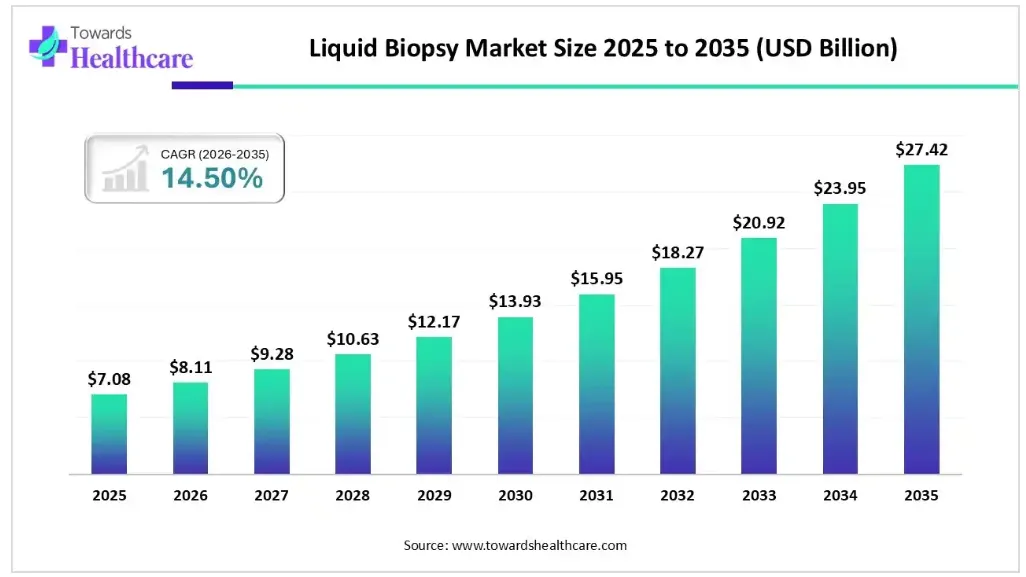
Ottawa, Oct. 14, 2026 (GLOBE NEWSWIRE) -- The global liquid biopsy market is projected to grow from USD 7.08 billion in 2025 to USD 27.42 billion by 2035, expanding at a compound annual growth rate (CAGR) of 14.5% from 2026 to 2035. At the same time, new regulatory developments, advances in circulating tumor DNA analysis, and growing pharmaceutical partnerships are reshaping the competitive landscape for cancer diagnostics. Towards Healthcare's market research identifies North America as the leading region and Asia Pacific as the fastest-growing market with next-generation sequencing, circulating nucleic acids, and therapy selection among the sector's major areas of activity.
Download a sample: Liquid Biopsy Market Report Sample to review the report's coverage and research scope.
Market Data Snapshot
| Market Indicator | Data | Business Implication | |
| Global market size, 2025 | USD 7.08 billion | Established commercial base for molecular diagnostics and precision oncology | |
| Projected market size, 2035 | USD 27.42 billion | Expanding opportunity for diagnostic developers, laboratories, and technology suppliers | |
| Forecast CAGR, 2026–2035 | 14.5 | % | Supports long-term investment in platforms, assays, and commercialization |
| U.S. market size, 2026 | USD 2.78 billion | Important near-term market for regulatory, clinical, and commercial strategies | |
| U.S. market forecast, 2035 | USD 8.90 billion | Significant opportunity for testing companies and companion diagnostic providers | |
| North America, 2025 | 46% of global market | Largest regional base for commercial deployment | |
| Middle East market, 2025 | USD 212.4 million | Emerging opportunity for access, distribution, and diagnostic infrastructure | |
| Middle East forecast, 2035 | USD 874.34 million | Long-term potential for regional market development | |
Market estimates and forecasts: Towards Healthcare's Liquid Biopsy Market report, updated September 10, 2026. Regional and country estimates should be interpreted within the report's stated market definitions.
What the Latest Market Data Shows
Liquid biopsy is moving beyond a niche alternative to tissue biopsy. The technology analyzes biomarkers including circulating tumor DNA (ctDNA), circulating tumor cells, RNA, and other molecular signals from blood and selected other body fluids. Its commercial value lies in enabling molecular profiling, therapy selection, treatment monitoring, and detection of residual or recurring disease without requiring a conventional tissue sample in every case.
The market's projected expansion reflects several overlapping demand pools: precision oncology, targeted cancer therapies, molecular monitoring, and the development of blood-based screening tests. These applications have different evidence requirements and commercial pathways, meaning companies need to assess them separately rather than treating all liquid biopsy products as interchangeable.
The U.S. liquid biopsy market alone is projected to increase from USD 2.78 billion in 2026 to USD 8.90 billion by 2035, at a CAGR of 13.82%. That outlook makes regulatory authorization, reimbursement, clinical utility, and relationships with pharmaceutical developers important competitive factors for diagnostic businesses.
Schedule a meeting: Connect with our expert team to discuss your requirements.
Segment trends and their commercial implications
| Segment | Market Position or Trend | What It Means for Decision-Makers |
| Next-generation sequencing (NGS) | Dominant technology segment | Supports comprehensive genomic profiling and complex biomarker analysis |
| Circulating nucleic acids | Leading biomarker category | Maintains the importance of sensitive ctDNA and related nucleic-acid assays |
| Cancer applications | Largest application category | Keeps oncology the core commercial market |
| Therapy selection | Leading clinical application | Creates opportunities linked to targeted drug development and companion diagnostics |
| Early screening | Expected to expand rapidly | Opens a potential growth market, but requires careful evaluation of clinical utility and regulatory evidence |
| Exosomes and microvesicles | Projected high-growth biomarker category | Encourages research into additional molecular signals and differentiated assay designs |
| Kits and reagents | Expected to grow rapidly | Creates recurring-revenue opportunities alongside instrument sales |
| Specialty clinics | Projected high-growth end-user category | Increases the importance of access, workflow integration, and test availability |
Segment positions and outlooks are based on Towards Healthcare's published market analysis.
The key strategic distinction is between tests used to guide treatment in patients with known cancer and tests intended to screen apparently healthy populations. Therapy-selection assays can be tied to specific treatment decisions and companion diagnostic pathways. Multi-cancer early-detection tests, by contrast, must demonstrate how their results should guide follow-up, how false positives and false negatives are managed, and whether screening improves meaningful health outcomes.
For manufacturers and investors, this distinction affects clinical-development priorities, product positioning, pricing assumptions, reimbursement planning, and the evidence required before scaling commercial deployment.
Latest Liquid Biopsy Industry News and Company Developments
The strongest competitive signals in 2026 are coming from companion diagnostics, minimal residual disease (MRD) testing, multi-cancer early detection, and expanding reimbursement. These developments show how commercial success increasingly depends on evidence, regulatory status, and access not just the ability to identify cancer-associated biomarkers.
1. Guardant Health expands companion diagnostic capabilities
On October 8, 2026, Guardant Health announced European approval of Guardant360 CDx as a companion diagnostic for AstraZeneca's camizestrant in advanced estrogen receptor-positive breast cancer. The development strengthens the connection between liquid biopsy testing and targeted treatment decisions.
In May 2026, the U.S. FDA also approved an expanded version of Guardant360 Liquid CDx, integrating genomic and epigenomic insights and assessing a genomic footprint 100 times wider than the previously approved version. The expansion illustrates the competitive value of broader molecular profiling and the potential to support additional treatment decisions.
For pharmaceutical companies, this creates opportunities to evaluate companion diagnostic partnerships earlier in drug development. For diagnostic developers, it increases the importance of assay validation, biomarker coverage, regulatory submissions, and integration into oncology treatment pathways.
2. Grail's Galleri advances toward a potential regulatory milestone
In September 2026, an FDA advisory panel voted 7–2 that the potential benefits of Grail's Galleri multi-cancer early-detection blood test outweighed its risks. The test is designed to identify signals associated with more than 50 cancer types from a blood sample.
However, the advisory decision is not an FDA marketing approval. Questions remain about sensitivity, false-positive results, detection of early-stage cancers, follow-up procedures, and evidence of improved patient outcomes. The distinction is commercially important: a favorable advisory vote can improve a product's regulatory outlook without guaranteeing approval, reimbursement, or widespread adoption.
Companies developing multi-cancer early-detection tests should therefore track clinical performance, confirmatory testing pathways, healthcare-provider acceptance, regulatory milestones, and payer decisions together.
3. MRD testing gains further access and clinical momentum
Quest Diagnostics announced in June 2026 that its Haystack MRD circulating tumor DNA test had received New York State approval, broadening access to testing for residual or recurring disease in solid-tumor cancers. The company stated that the test was then authorized for patient testing in all 50 U.S. states.
Meanwhile, Natera's Signatera received Japanese regulatory approval for adjuvant colorectal cancer applications in 2026, and expanded guideline recognition has supported interest in ctDNA-based MRD testing across selected cancer settings.
These developments make MRD testing a strategically important area for monitoring cancer recurrence and treatment response. They also highlight the need to distinguish regulatory clearance, clinical guideline inclusion, reimbursement coverage, and demonstrated clinical utility four different factors that affect market adoption.
Explore further insights: Visit the Liquid Biopsy Market report for market forecasts, segment analysis, regional intelligence, and company coverage.
Company intelligence snapshot
| Company | Recent Development | Strategic Significance |
| Guardant Health | Expanded Guardant360 Liquid CDx authorization and European companion diagnostic approval | Strengthens precision-oncology positioning and pharmaceutical partnerships |
| Grail | Galleri received a favorable FDA advisory panel vote in September 2026 | Creates a potential pathway toward broader multi-cancer screening, subject to further regulatory decisions |
| Quest Diagnostics | Haystack MRD received New York State approval in June 2026 | Broadens access to ctDNA-based residual disease testing |
| Natera | Signatera received Japanese approval for adjuvant colorectal cancer applications | Supports international expansion of MRD testing |
| Freenome | SimpleScreen Lung received FDA Breakthrough Device Designation in 2026 | Advances development of a blood-based lung cancer screening test |
The competitive implication is clear: liquid biopsy providers are pursuing distinct commercial strategies. Some are focusing on treatment selection and companion diagnostics; others are building MRD monitoring portfolios or pursuing multi-cancer screening. Investors and business-development teams need to benchmark these strategies separately.
Where the Next Market Opportunities Are Emerging
Companion diagnostics and precision oncology
Liquid biopsy can help identify molecular alterations relevant to targeted therapies when tissue testing is unavailable, insufficient, or difficult to obtain. Pharmaceutical companies can use these capabilities to support clinical trial enrollment, biomarker stratification, and companion diagnostic development.
The opportunity for diagnostic businesses is to establish partnerships around specific drug-development programs and cancer indications rather than relying exclusively on broad testing portfolios.
Multi-cancer early detection
Blood-based screening tests could expand the addressable population beyond patients already diagnosed with cancer. However, commercial opportunity depends on demonstrating clinical value, managing false-positive and false-negative results, establishing confirmatory diagnostic pathways, and securing payer coverage.
Businesses should evaluate these requirements before using potential screening populations to build revenue forecasts.
Asia Pacific expansion
Asia Pacific is projected to be the fastest-growing regional market. China, Japan, India, South Korea, and Australia offer different combinations of healthcare infrastructure, oncology research, diagnostic capabilities, reimbursement environments, and patient access.
Companies considering regional expansion should compare country-level demand, laboratory capabilities, regulatory requirements, distribution networks, local partnerships, and test affordability before committing resources.
AI-enabled molecular analysis
AI and computational biology can support biomarker identification, signal interpretation, and analysis of complex molecular datasets. Their commercial contribution depends on analytical validation, reproducibility, integration into laboratory workflows, and evidence that improved interpretation translates into meaningful clinical utility.
Reagents, laboratory services, and manufacturing
The projected growth of kits and reagents creates opportunities for recurring revenue, while increased testing volumes can support laboratory automation, sample-processing technologies, sequencing workflows, and specialized diagnostic services.
Suppliers should monitor instrument compatibility, reagent demand, production scalability, quality requirements, and laboratory purchasing criteria.
Risks and Challenges Companies Should Monitor
The market's growth potential does not eliminate commercial and clinical uncertainty. Key issues include:
- Clinical validation: Test performance can vary by cancer type, stage, biomarker, and intended use.
- False results: False positives can trigger unnecessary follow-up procedures, while false negatives can create false reassurance.
- Regulatory differences: Approval or authorization in one jurisdiction does not automatically establish market access elsewhere.
- Reimbursement: Payer coverage, patient out-of-pocket costs, and demonstrated clinical utility influence testing volumes.
- Competition: Established diagnostic companies and emerging developers are competing across overlapping applications.
- Data and workflow integration: Laboratories and healthcare providers need reliable sample handling, interpretation, reporting, and integration with clinical systems.
These factors should be incorporated into product prioritization, investment assessments, market-entry planning, and commercial forecasts.
How Towards Healthcare Helps Companies Navigate the Liquid Biopsy Market
Towards Healthcare Research & Consulting supports pharmaceutical companies, biotechnology developers, diagnostic manufacturers, laboratories, investors, and suppliers with market-specific intelligence that connects industry developments to business decisions.
| Towards Healthcare Solution | What the Client Gets | Application in Liquid Biopsy |
| Master Dataset | Structured information on companies, products, biomarkers, indications, countries, technologies, facilities, partnerships, investments, and launches | Identify competitors, potential customers, market-entry opportunities, and business-development targets |
| Towards Healthcare Quadrant | Company benchmarking, portfolio comparisons, capability assessment, and strategic positioning | Compare liquid biopsy providers across technology, clinical applications, geographic presence, and commercial strategy |
| Interactive Dashboard | Organized tracking of market trends, competitors, products, regions, investments, and technology developments | Monitor regulatory milestones, launches, partnerships, and competitive changes without relying solely on static reports |
| Quality & Manufacturing Intelligence | Relevant information on laboratory infrastructure, suppliers, instruments, reagents, production capabilities, and operational developments | Support sourcing, supplier assessment, capacity planning, and quality-related intelligence |
| Customized Research | Market-entry studies, demand analysis, pricing, customer intelligence, company profiling, technology assessment, M&A intelligence, and GTM strategy | Evaluate country opportunities, product positioning, partnership potential, investment options, and commercialization pathways |
Master Dataset and competitive intelligence
A liquid biopsy dataset can bring together information on diagnostic companies, assay portfolios, biomarker types, cancer indications, testing platforms, clinical applications, commercial partnerships, and geographic presence.
Business-development teams can use this information to identify potential pharmaceutical partners, clinical research collaborators, laboratory customers, and regional distributors. Investors can compare company portfolios and development stages, while manufacturers can assess demand opportunities for reagents, instruments, and associated services.
Towards Healthcare Quadrant
The quadrant framework can support comparisons based on technology capabilities, product breadth, clinical applications, partnerships, geographic presence, and strategic development. It helps decision makers identify competitors, assess differentiation, and evaluate potential collaboration or acquisition targets.
Interactive Dashboard and ongoing intelligence
An interactive dashboard can bring together market indicators, company announcements, product developments, clinical milestones, regulatory decisions, reimbursement changes, and regional expansion activity.
This enables commercial, strategy, and business-development teams to monitor a changing market and evaluate how individual developments may affect their priorities.
Customized research
Projects can address specific business questions, including:
- Which countries offer the strongest opportunities for liquid biopsy market entry?
- Which diagnostic companies are potential partners for a pharmaceutical pipeline?
- How do competing MRD and companion diagnostic products differ?
- What factors influence laboratory purchasing and test adoption?
- Which technologies and suppliers are relevant to a new product launch?
- Which companies or technologies warrant further investment or acquisition assessment?
Market intelligence can be updated monthly, quarterly, every six months, or annually, depending on client requirements. Monthly tracking is particularly relevant for regulatory decisions, product launches, clinical developments, partnerships, and reimbursement changes, while quarterly and annual reviews can support commercial planning and investment decisions.
Access Liquid Biopsy Market Intelligence
- Download a sample: Liquid Biopsy Market Report Sample to review the report's coverage and research scope.
- Buy this report: Proceed to Checkout to select a report license and purchase option.
- Schedule a meeting: Connect with our expert team to discuss your requirements.
- Explore further insights: Visit the Liquid Biopsy Market report for market forecasts, segment analysis, regional intelligence, and company coverage.
Related Reports
- U.S. Liquid Biopsy Market
- Breast Cancer Liquid Biopsy Market
- Cancer Diagnostics Market
- Cancer Biopsy Market
- U.S. Non-Invasive Cancer Diagnostics Market
- Next Generation Cancer Diagnostics Market
- AI in Cancer Diagnostics Market
- Clinical Diagnostics Market
- Oncology Molecular Diagnostics Market
- Molecular Diagnostics Market
Partner
Connect With Us
- USA: +1 804 441 9344
- APAC: +61 485 981 310 | +91 87933 22019 | +65 3105 1271
- Europe: +44 7383 092 044
- Email: sales@towardshealthcare.com
Follow Towards Healthcare
For relevant samples, case studies, and examples, fill out the form on the Towards Healthcare website or contact the expert team at sales@towardshealthcare.com.







Comments (0)
Login to join the conversation
Login / RegisterNo comments yet. Be the first to comment!