
U.S. Synchrophasor Market to Reach USD 0.58 Billion by 2035 as North America Leads with 40.0% Share and Asia Pacific Records the Fastest Growth at 16.8% CAGR
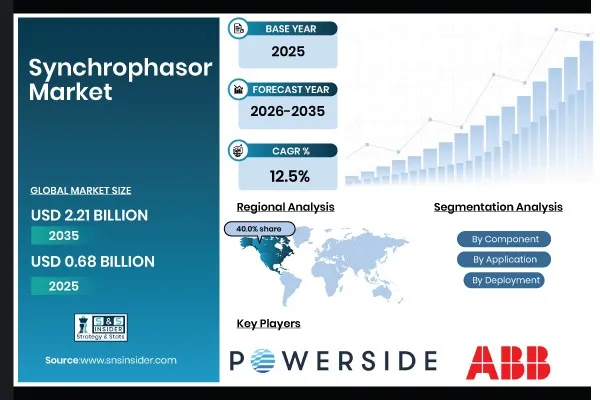
Austin, Sept. 15, 2026 (GLOBE NEWSWIRE) -- According to SNS Insider, the global Synchrophasor Market was valued at USD 0.68 Billion in 2025 and is projected to reach USD 2.21 Billion by 2035, registering a CAGR of 12.5% from 2026 to 2035. Market growth will be attributed to greater regulatory requirements for the deployment of phasor measurement units, growing investments made by utilities for situational awareness in the wide area, and AI-based state estimation and fault diagnosis. Increasing renewable energy generation, inter-regional data exchange, and expanding distribution monitoring are other factors that are driving the need for GPS-synchronized voltage, current, and frequency measurements.
In 2026, The federal approval for the update of the Open Access Transmission Tariff by PJM became effective, obliging all newly built power plants above 100 MW capacity to install PMUs and transmit synchrophasors data to the network operators. The extension brought the number of PJM devices up to 719 PMUs in 488 substations. In 2025, the company Powerside extended deployment of its microPMUs to study distribution network issues related to renewable energy penetration and grid stability.
Download the Synchrophasor Market Sample Report: https://www.snsinsider.com/sample-request/10929
Synchrophasor Market Key Highlights
- Market size, 2025: USD 0.68 Billion
- Market forecast, 2035: USD 2.21 Billion
- CAGR: 12.5% from 2026 to 2035
- Largest region: North America, with 40.0% share in 2025
- Fastest-growing region: Asia Pacific, at 16.8% CAGR from 2026 to 2035
- Largest type: Type I, with 62% share in 2025
- Fastest-growing type: Type II
- Largest component: PMU Hardware, with 65% share in 2025
- Fastest-growing component: Software & Analytics
- Largest application: Fault Analysis, with 28% share in 2025
- Fastest-growing application: Renewable Energy Integration
- Largest end use: Power Transmission, with 44% share in 2025
- Fastest-growing end use: Power Distribution
- Largest deployment: On-Premise, with 71% share in 2025
- Fastest-growing deployment: Cloud-Based
Market Relevance
The application of synchrophasors becomes more and more critical in modern grids because this technology offers high-speed, time-coordinated measurements of voltage, current, phase angles, and frequency. In comparison with traditional SCADA systems, synchrophasor systems offer significantly increased speed when analyzing the condition of power systems in real-time. The use of synchrophasor systems is beneficial for fault analysis, state estimation, renewable energy integration, stability analysis, disturbances detection, etc.
Synchrophasor Market Overview
The Synchrophasor Market comprises phasor measurement units, communication systems, data concentrators, software, and analytics solutions. Type I synchrophasors have continued to be dominant due to their reliability and use in grid monitoring applications, which need synchronized measurement capabilities with relatively low bandwidths.
Strategic Market Outlook
There is great potential in the use of synchrophasor analysis driven by AI as utilities transition from data logging to more sophisticated grid management systems that are predictive and automated. Fast measurements offer valuable insight into instabilities and disturbances as well as equipment performance, which is beyond the capacity of existing measurement systems. Analytics vendors that can analyze big data in synchrophasors will be well-positioned for success.
Synchrophasor Market Regional Analysis
North America dominated the Synchrophasor Market in 2025, taking the highest market share of 40.0%, driven by government funding, mandatory installation regulations for PMUs, high participation of transmission operators, and availability of leading PMU suppliers. Cooperation between the transmission owners and independent system operators facilitated rapid implementation of wide-area monitoring network within the region. U.S. Synchrophasor Market had an estimated value of approximately USD 0.23 Billion in 2025 and will be approximately USD 0.58 Billion by 2035, growing at a CAGR of approximately 9.8% during the forecast period of 2026 to 2035.
Asia Pacific is the fastest-growing region with a CAGR of 16.8% during 2026 to 2035 driven by urbanization, industrialization, large scale modernization of power grids, and increasing usage of renewable sources. China held a share of approximately 36.40% in terms of revenues generated in Asia Pacific in 2025 backed by investments from State Grid and countrywide PMU standards. India and Japan are also playing an important role through renewables integration and advanced grid monitoring.
Buy the Synchrophasor Market Report with Competitive Analysis and 2035 Forecast: https://www.snsinsider.com/checkout/10929
Synchrophasor Market Segment Analysis
By Type: Type I dominated the market with a 62% share in 2025 was attributed to its usage in synchronous grid monitoring and lesser bandwidth needs. The most rapidly growing type is type II due to the rising demand for applications such as wide-area state estimation and dynamic line rating.
By Component: In 2025, PMU Hardware is expected to hold a 65% market share owing to the crucial function of Phasor Measurement Units as the core sensing hardware used in WAMSs. Software & Analytics is the segment that is expected to grow the fastest owing to the increasing use of artificial intelligence/machine learning for analysis of synchrophasors by utilities.
By Application: Fault Analysis dominated with a 28% share in 2025, supported by utilities’ need to detect disturbances quickly and prevent local faults from escalating into system-wide outages. Renewable Energy Integration is the fastest-growing application as variable wind and solar generation increases the need for real-time monitoring of grid stability, topology changes, and islanding risks.
By End Use: Power Transmission held the largest share of 44% in 2025, owing to the initial use of PMU in high voltage substations where there was high risk associated with grid instability. Power Distribution represents the fastest growing end-user application since micro-PMU enables synchrophasor technology to be used in low voltage systems.
By Deployment: On-Premise was the market leader with a share of 71% in 2025, owing to the utilities' tendency to have more control over critical grid monitoring infrastructure and data. Cloud-Based was the highest growing segment, considering the utilities' tendency to test scalable analytics platforms for processing synchrophasor data at high frequency levels.
Synchrophasor Market Key Trends
- Expanding regulatory mandates requiring PMU installation on new generation facilities continue accelerating synchrophasor network expansion.
- Growing utility adoption of AI-driven state estimation continues improving predictive fault detection across interconnected grids.
- Rising distribution-level micro-PMU deployment continues extending wide-area monitoring visibility beyond transmission-class substations.
- Increasing renewable energy penetration continues strengthening demand for synchrophasor-based grid stability and islanding detection tools.
- Growing cross-regional data sharing among independent system operators continues expanding synchrophasor network interoperability.
Competitive Landscape
Synchrophasor Market comprises PMU vendors, grid analytics solution providers, electrical equipment suppliers, simulation technology companies, communication companies, and utility software suppliers that provide solutions for T&D operations. Differentiation among the competitors is achieved through accuracy, synchronization capability, analytics capabilities, interoperability, adoption of micro-PMUs, reliable communications, and integration with SCADA/grid management systems.
In 2026, PJM’s federally approved Open Access Transmission Tariff update took effect, requiring all new generating facilities of 100 MW or greater to install PMUs and stream synchrophasor data to the grid operator. The network expanded to approximately 719 devices across 488 substations. In 2025, Powerside expanded deployment of its microPMU synchrophasor technology for distribution-level monitoring, building on ARPA-E-funded research to support renewable penetration and grid stability applications across international utility and research partnerships.
Major key players include
Schweitzer Engineering Laboratories, Inc., Powerside, ABB Ltd, Siemens AG, GE Vernova Inc., ETAP (Operation Technology, Inc.), Hitachi Energy Ltd., Electric Power Group, LLC, Arbiter Systems, Inc., RTDS Technologies Inc., NR Electric Co., Ltd., Kalki Communication Technologies Pvt. Ltd. (Kalkitech), Mitsubishi Electric Corporation, Toshiba Energy Systems & Solutions Corporation, Doble Engineering Company, Eaton Corporation plc, Itron, Inc., Landis+Gyr Group AG, NARI Technology Co., Ltd., Megger Group Limited
Explore the Complete Synchrophasor Market Report: https://www.snsinsider.com/reports/synchrophasor-market-10929
About Us:
SNS Insider is one of the leading market research and consulting agencies that dominates the market research industry globally. Our company's aim is to give clients the knowledge they require in order to function in changing circumstances. In order to give you current, accurate market data, consumer insights, and opinions so that you can make decisions with confidence, we employ a variety of techniques, including surveys, video talks, and focus groups around the world.
CONTACT: Contact Us:
Rohan Jadhav - Principal Consultant
Phone: +1-315-961-9094 (US)







Comments (0)
Login to join the conversation
Login / RegisterNo comments yet. Be the first to comment!