
The Global Aluminum Foam for Construction Market is expanding steadily as building codes and procurement standards increasingly reward verified thermal, acoustic, and fire performance over baseline compliance. Rising demand for energy-efficient building envelopes, stricter fire-safety and passive protection requirements, and growing acoustic comfort expectations in dense urban construction are reinforcing adoption of closed-cell and open-cell aluminum foam systems. Asia Pacific leads global consumption on the back of rapid urbanization and large-scale infrastructure development, while North America and Europe continue to advance through specification-driven, compliance-disciplined procurement. According to Verified Market Research®, the Aluminum Foam for Construction Market is set for measured, multi-application growth through 2033, underpinned by technology-led improvements in foam manu
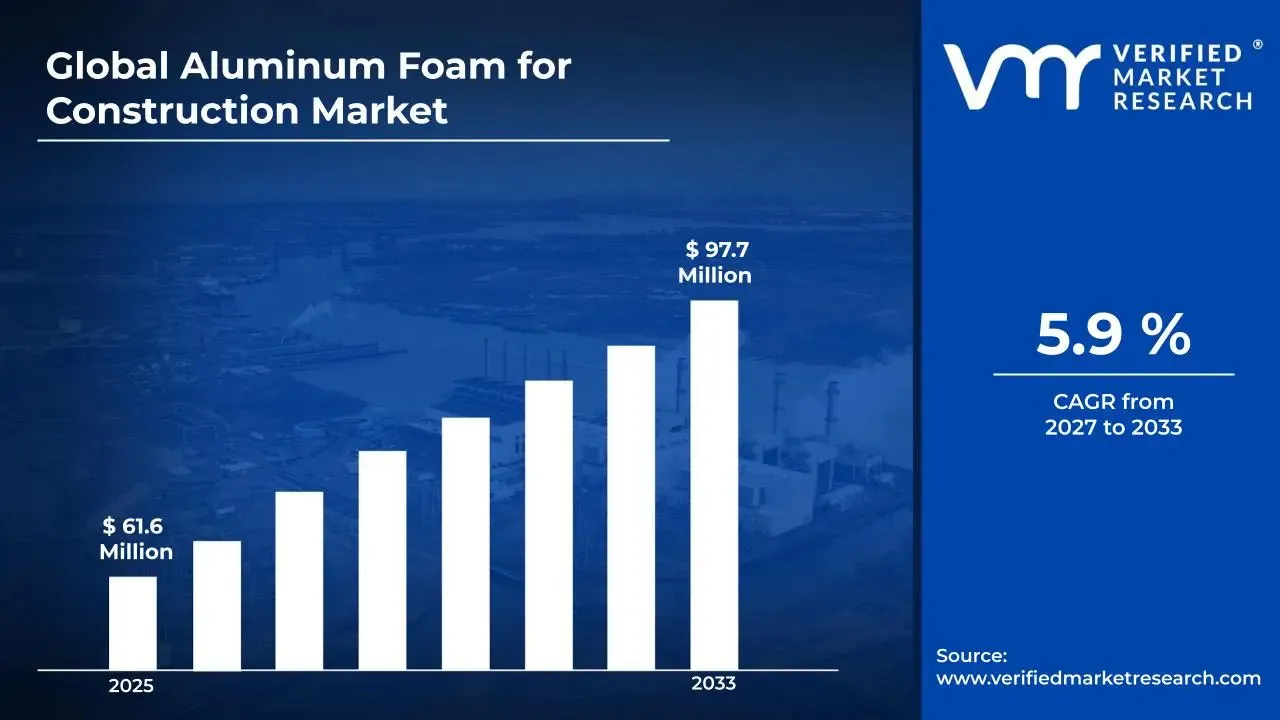
LEWES, Delaware, Sept. 01, 2026 (GLOBE NEWSWIRE) -- The Global Aluminum Foam for Construction Market Size was valued at USD 61.60 Million in 2025 and is projected to reach USD 97.70 Million by 2033, growing at a Compound Annual Growth Rate (CAGR) of 5.9% during the forecast period of 2025 to 2033, according to a newly published industry analysis by Verified Market Research®. The report notes that this growth trajectory reflects steady adoption of advanced insulation and building-envelope solutions, alongside expanding use cases in façade design and acoustic performance, rather than a single dramatic demand catalyst. The Aluminum Foam for Construction Market Size outlook points to a scaling phase in which adoption widens gradually across commercial, industrial, and residential construction segments.
Verified Market Research® further reports that the market's analysis covers five regions, three end-user categories, three application segments, two product types, and ten key industry players, providing a comprehensive framework for understanding the Aluminum Foam for Construction Industry across its full value chain from raw material and manufacturing inputs to project-level specification and installation.
Download a free sample to access exclusive Insights, Data Charts, And Forecasts From Aluminum Foam for Construction Market Sample Report
Market Overview: Defining the Aluminum Foam for Construction Market
The Aluminum Foam for Construction Market covers the supply and adoption of engineered aluminum foam materials and foam-based building system components formulated specifically for architectural and building-envelope performance. Participation in the market is defined by the presence of an aluminum foam structure used for construction-relevant functions such as enhanced thermal resistance, acoustic control, and fire-relevant material behavior either as a standalone insulation board or as a functional layer within a broader construction assembly.
According to the report, the primary function served by the market is performance enablement at the material level for the building sector. Aluminum foam's value proposition in construction stems from its lightweight cellular architecture and its capacity to be engineered for specific permeability, density, and mechanical integrity characteristics that align with thermal management, acoustic attenuation, and fire performance requirements. The scope of the Aluminum Foam for Construction Market is therefore limited to activity where the foam itself is the controlled variable delivering the construction outcome, rather than where aluminum appears only as a conventional cladding metal or generic structural component.
The report draws clear scope boundaries to avoid confusion with adjacent industries. Conventional polymer foams for insulation such as polyurethane and polyethylene foam products are excluded because they rely on organic polymer chemistry and different thermal, acoustic, and fire behavior mechanisms. Standard rigid metal panels or perforated metal sheets are also excluded, as they do not provide a three-dimensional cellular foam architecture with tunable cell structure and typically deliver only surface-level acoustic and aesthetic functions. Additionally, aerogels and other high-performance non-metal insulation media are excluded because they are governed by distinct manufacturing processes and system integration logic, even when addressing similar building-envelope problems.
Understanding these exclusions matters for stakeholders evaluating the Aluminum Foam for Construction Market Growth story, as it clarifies that the market's momentum is driven specifically by foam-morphology-dependent performance rather than broader metal building products.
Download a free sample to access exclusive Insights, Data Charts, And Forecasts From Aluminum Foam for Construction Market Sample Report
Key Growth Drivers Fueling Aluminum Foam for Construction Market Growth
Verified Market Research® identifies three core drivers currently propelling the Aluminum Foam for Construction Market forward, each reinforced by supporting ecosystem shifts in supply chain standardization and manufacturing capacity.
1. Building Envelope Upgrades Intensifying Insulation Performance Requirements
Stricter envelope efficiency goals are creating direct demand for insulation materials capable of delivering stable thermal performance across real-world building geometries. Aluminum foam systems translate these goals into thinner, more system-integrated constructions where insulation thickness, mechanical durability, and long-term dimensional stability must align. As retrofitting cycles expand across major building stock globally, specifications increasingly favor assemblies that reduce energy losses and simplify installation planning a dynamic that is directly expanding demand for aluminum foam for construction in both commercial retrofits and new-build projects.
2. Fire-Safety and Passive Protection Standards Driving System-Level Material Selection
Where building codes require consistent fire response and passive protection strategies, insulation materials face growing scrutiny not only for baseline flame behavior but also for how they integrate within full assemblies. Aluminum foam for construction supports these system-level compliance needs by enabling designers and contractors to build layered solutions with predictable performance across façade, partition, and mechanical spaces. As compliance documentation and inspection expectations tighten, these material benefits are translating into more frequent specification inclusion, supporting faster market penetration in high-risk construction scopes such as industrial facilities.
3. Product Evolution Toward Tailored Pore Structures
Advances in manufacturing control are allowing aluminum foam for construction to better match pore-structure requirements, supporting more precise tuning for acoustic absorption, thermal behavior, and structural integration. This evolution reduces design trade-offs, as designers can target performance goals without over-relying on multiple separate components. As façade and interior design increasingly demand integrated solutions, specification teams are favoring material variants aligned with the application envelope improving adoption rates for aluminum foam across acoustic insulation, thermal insulation, and cladding-adjacent systems.
Ecosystem-Level Reinforcement
At the ecosystem level, the Aluminum Foam for Construction Market benefits from evolving supply chains that increasingly treat aluminum foam as a system component rather than a commodity insulation input. Standardization in testing and application guidance is helping procurement and specification teams compare performance claims more consistently across suppliers, lowering friction in tendering. Capacity expansion and consolidation among foam producers is also improving delivery reliability and part-to-part consistency, reducing contractor risk during schedule-sensitive construction projects.
Emerging Opportunities in the Aluminum Foam for Construction Industry
Verified Market Research® highlights several opportunity clusters that are expected to shape capital allocation and product development within the Aluminum Foam for Construction Market through 2033.
- Retrofit Demand for Acoustic Performance: Dense building stock across commercial and residential portfolios has created a mismatch between current acoustic expectations and installed assemblies. Aluminum foam for construction can be configured as cut-to-fit panels or bonded layers to restore sound attenuation without full envelope demolition, an opportunity that is expanding as refurbishment cycles shorten and stakeholders seek upgrades that minimize downtime.
- Integrated Fire and Thermal Assemblies: Thermal and fire protection requirements are increasingly converging within the same envelope specification, creating procurement inefficiency when materials are sourced and tested separately. Aluminum foam for construction supports integrated layer design for Thermal & Fire Protection use cases, enabling fewer interface gaps between insulation, cladding substrates, and detailing translating into stronger design wins for closed-cell configurations.
- Standardized Panel Formats for Architectural Cladding: Architectural Design & Cladding projects often face schedule pressure from bespoke detailing and long coordination loops. Standardized aluminum foam panel formats can reduce design iteration, improve compatibility with mounting and finishing workflows, and make cost and performance more predictable for specifiers, enabling suppliers to capture repeat procurement.
- Process Innovation to Reduce Variability: Opportunities cluster around improving consistency of pore architecture, density distribution, and surface integrity during production, since project acceptance depends on predictable performance and variability drives rework and rejection risk.
- Regional Fulfillment and Supply Chain Models: Operational opportunities exist where lead time and procurement reliability influence whether projects switch to aluminum foam solutions, particularly in regions where materials must travel long distances or distribution is fragmented.
The report notes that opportunity intensity varies by end-user: commercial projects are most influenced by retrofit and operational-continuity needs; industrial sites are shaped by harsh operating environments and maintenance constraints that increase the value of robust insulation layers and residential demand is driven by comfort, quieter living, and lower disruption during upgrades.
Market Challenges and Restraints Facing the Aluminum Foam for Construction Market
Despite positive Aluminum Foam for Construction Market Growth prospects, Verified Market Research® identifies several structural restraints that could moderate the pace of adoption.
Higher System-Level Cost and Uncertain Total Savings
Aluminum Foam for Construction Market adoption faces cost pressure because foam materials, forming, and integration into assemblies can raise upfront spending relative to conventional insulation. Buyers often discount long-term benefits when payback timing depends on installation quality, retrofit scope, and energy price volatility. This uncertainty delays tender decisions, limits repeat orders, and compresses margins for contractors who must standardize purchasing and installation practices before scaling.
Regulatory and Certification Gaps for Novel Composite Foam Assemblies
Market growth is constrained when building code pathways and approval documentation lag behind technical performance claims. Projects require evidence for thermal performance, fire behavior, smoke or toxicity considerations, and acoustic ratings at the assembly level. Where certification is incomplete or inconsistent across regions, specifiers face higher approval risk, insurers may adjust underwriting terms, and permitting timelines lengthen reducing the number of projects that reach procurement stages.
Manufacturing Variability and Supply Capacity Constraints
Aluminum foam performance depends on controlled pore structure and uniformity, which can be sensitive to production parameters. When supply capacity cannot reliably meet construction schedules, availability fluctuates by batch and lead time, forcing substitutions or scope reductions. Inconsistent material characteristics also increase the burden of onsite verification, retesting, or redesign, discouraging repeat specification and reducing scalability as project pipelines expand.
The report notes these restraints affect segments unevenly: commercial projects are most constrained by compliance uncertainty and approval timelines; industrial demand is held back by manufacturing availability and schedule reliability and residential adoption is most sensitive to cost and perceived value under installer-driven decision-making.
Technology and Innovation Trends Shaping the Aluminum Foam for Construction Industry
According to Verified Market Research®, technology is a primary determinant of capability, efficiency, and adoption within the Aluminum Foam for Construction Market. Innovation spans incremental improvements such as better foam uniformity and process stability alongside more transformative shifts that broaden feasible building applications, including envelope assemblies and acoustically tuned systems.
Microstructure Control for Consistent Acoustic and Thermal Behavior
Manufacturing improvements are increasingly focused on tightening the link between process conditions and foam cell characteristics. The industry is refining melt preparation, foaming conditions, and quench or solidification pathways to limit structural heterogeneity, directly addressing a historical constraint in construction adoption where inconsistent microstructure complicates performance claims for acoustic and thermal insulation.
Scalable Shaping and Composite Integration for Construction-Ready Formats
A second innovation area involves translating foam material into practical building products through shaping, surface conditioning, and integration into composite assemblies. By improving formability and compatibility with structural or finishing layers, manufacturers are reducing installation friction and supporting consistent mounting or attachment methods enhancing scalability for broader deployment in architectural design and cladding.
Process Efficiency and Quality Assurance to Reduce Production Variability
Technological evolution is also targeting manufacturing throughput and quality assurance. By strengthening process control and inspection practices, the industry is reducing variability that can otherwise lead to scrap, rework, or delayed qualification improving reliability for long-running building programs across residential and industrial end-use segments.
Market Trend Highlights
- Closed-Cell Foam as the Default Specification: The market is trending toward greater specification discipline around closed-cell aluminum foam, particularly where assemblies must deliver stable thermal behavior, tightening qualification requirements for new entrants.
- Assembly-Level Acoustic Performance Verification: Acoustic insulation use is increasingly specified as part of a broader wall or ceiling assembly rather than as a standalone foam insert, pushing competitive behavior toward collaboration on installation compatibility.
- Standardized Layer Architectures for Thermal & Fire Protection: The market is shifting toward repeatable construction layer architectures, favoring suppliers that can support standardized detailing guidance and documentation readiness.
- Customization-Led Growth in Architectural Cladding: Architectural Design & Cladding adoption is expanding primarily through project-specific design iterations rather than generic façade rollouts.
- System-Oriented Manufacturing Partnerships: Distribution and manufacturing partnerships are becoming more system-oriented across commercial, industrial, and residential segments, rewarding vendors with demonstrated system-integration capability.
Industry Use Cases and End-User Applications
The Aluminum Foam for Construction Market serves distinct end-user categories and application scenarios, each shaping demand through different procurement criteria and performance priorities.
By Application
Acoustic Insulation applications emphasize attenuation of airborne sound and control of reverberation in spaces with frequent occupancy or continuous mechanical operation, with demand often driven by commercial and residential high-occupancy buildings where noise reduction is a recurring specification requirement.
Thermal & Fire Protection use cases prioritize envelope heat-flow management and risk reduction within layered wall or roof systems, and the market distribution typically strengthens where building envelope upgrades and code-driven compliance are most active, including industrial and commercial retrofits.
Architectural Design & Cladding applications focus on integration into building skins, where lightweight specification and tailored surface behavior are operationally decisive for fit, finish, and durability, generally spreading across commercial and industrial projects due to façade performance requirements and aesthetic integration needs.
By End-User
Commercial end-users typically emphasize building-envelope performance, compliance, and lifecycle considerations for office, retail, and other public-facing assets. This segment often adopts advanced envelope materials earlier due to tighter performance requirements and the ability to standardize specification across multi-site portfolios.
Industrial end-users focus on performance under demanding operating environments where noise control and thermal management may be paired with safety requirements, with the report noting that industrial facilities often escalate adoption when passive protection and system reliability become procurement necessities.
Residential end-users prioritize buildability, occupant comfort, and material performance in the context of housing typologies. Residential demand often follows commercial and industrial adoption with narrower project scopes, producing a slower adoption curve until costs, installation familiarity, and local availability stabilize.
High-Impact Use Cases Identified in the Report
- Facade Retrofit Assemblies for Acoustic Control: In dense urban districts, aluminum foam layers are inserted within renovation build-ups around windows, spandrels, and facade cavities to reduce noise intrusion from transportation and adjacent activities without adding excessive mass.
- Industrial Roof and Wall Thermal Plus Safety Layers: Aluminum foam is installed in wall or roof assemblies where stable thermal performance supports energy management while layered system design addresses construction safety expectations under demanding environmental cycles.
- Residential Envelope Build-Ups: Aluminum foam is integrated into wall cavities, roof insulation packages, or energy-efficiency retrofits where homeowners and developers expect reduced heat loss and consistent interior temperature, combined with fire-aware installation simplicity.
Regional Outlook for the Aluminum Foam for Construction Market
Verified Market Research® reports that Asia Pacific leads the Aluminum Foam for Construction Market with approximately 35% market share, driven by rapid urbanization and extensive infrastructure projects. Adoption patterns across all five covered regions reflect differences in building-code priorities, construction cycles, and industrial capability.
North America
North America behaves as an innovation-driven, specification-sensitive market rather than a purely price-driven one. Demand is anchored by a dense mix of commercial and industrial end-users, where building envelope performance is evaluated alongside acoustic comfort and fire-related compliance during design and permitting. The region's technology adoption is reinforced by mature testing and engineering workflows, enabling faster movement from prototype to qualified assemblies. Key factors shaping the market include a project mix concentrated in commercial and industrial portfolios, an enforcement-driven compliance culture for envelope and fire performance, an established engineering and testing ecosystem that accelerates qualification, investment cycles tied to retrofit intensity and facility modernization, and a mature supply chain supporting consistent specification delivery.
Europe
Europe is shaped as a regulation-disciplined market, where specifications often determine material selection as much as cost and performance. EU-wide harmonization of thermal efficiency, fire performance, and acoustic requirements tightens the link between compliance documentation and procurement decisions. Key factors include harmonized performance requirements across EU member states, sustainability and embodied-impact scrutiny that drives demand for lower-waste insulation and façade solutions, cross-border industrial integration among producers, converters, and installers, strong quality assurance and certification expectations, regulated innovation with faster approval-ready iteration cycles, and public policy influence on renovation and code compliance.
Asia Pacific
Asia Pacific is characterized by expansion-led demand, supported by rapid industrialization, high urban growth, and a large construction footprint across developed and emerging economies. Japan and Australia tend to emphasize performance-led specifications for façade, insulation, and acoustic systems, while India and parts of Southeast Asia typically prioritize cost-effective building solutions and faster project delivery cycles. Key factors shaping the region include industrial scale-up and capacity buildout, population-driven construction demand with differing building archetypes, cost competitiveness supported by manufacturing ecosystems, infrastructure investment and urban expansion cycles, uneven regulatory and procurement environments, and rising investment in building modernization.
Latin America
Latin America represents an emerging, gradually expanding segment, with demand concentrated around Brazil, Mexico, and Argentina. Order patterns tend to follow construction and industrial cycles, while currency volatility and fluctuating investment levels can delay specification decisions. Key factors include currency volatility and budget timing, uneven industrial development across countries, import and external supply chain dependence, infrastructure and logistics constraints, regulatory variability and policy inconsistency, and selective foreign investment that accelerates project-led penetration.
Middle East & Africa
The Middle East & Africa region behaves as a selectively developing market rather than a uniformly expanding one. Gulf economies act as demand anchors through megaproject construction, real-estate modernization, and local manufacturing agendas, while South Africa and larger African metros shape nearer-term volumes for building envelope and industrial insulation upgrades. Key factors include policy-led build and diversification cycles in Gulf economies, infrastructure gaps and uneven industrial readiness across African markets, high reliance on imports for specialty construction materials, concentrated demand in urban and institutional centers, regulatory inconsistency across countries, and gradual market formation through public-sector and strategic projects.
Competitive Landscape of the Aluminum Foam for Construction Market
The Aluminum Foam for Construction Market is characterized as specialist-driven and moderately fragmented, with production concentrated among firms possessing expertise in metal foam formulation, cell-structure control, and downstream integration into construction-relevant systems. Verified Market Research® identifies Cymat Technologies Ltd. as the market leader, owing to its established metal foam expertise and construction product integration. The competitive analysis covers 10 key players, with the following companies profiled in detail:
- Alantum Corporation - Operates as a technology and supply-oriented materials specialist focused on aluminum foam formulations aligned to construction use cases, differentiated by its ability to translate foam microstructure into consistent functional outcomes for thermal management and surface-ready formats suitable for building integration.
- Cymat Technologies Ltd. (including its Alusion brand) - Functions as the market-leading, application-focused innovator, shaping demand through system-level thinking that converts metal foam from a material buy into a performance component for architectural and façade-adjacent solutions.
- ERG Aerospace Corporation - Brings aerospace-heritage process discipline, traceability, and engineering-grade manufacturing consistency to construction-adjacent metal foam markets, positioning itself as a lower-uncertainty partner for customers seeking predictable cell structure and dimensional stability.
- Havel Metal Foam GmbH - A specialized manufacturer differentiated by its ability to tailor porosity and geometry to specific application constraints, supporting a broader menu of foam characteristics without requiring bespoke redesign for every project.
- Pohltec Metalfoam GmbH - A capability-driven supplier competing through materials engineering and application fit, with differentiation expressed through controllability and support for qualification workflows requiring documentation and consistent output.
Additional market participants noted in the report include Alusion (Cymat Technologies Ltd.), Hollomet GmbH, Alufoam GmbH, American Elements, and Spectra-Mat Inc. Collectively, these participants reinforce a spectrum of roles across the value chain, ranging from niche materials and component engineering specialists to providers supporting advanced material pathways and targeted application needs. The report notes that over the 2025 to 2033 period, the industry is expected to move toward more specification-led adoption, where competitive advantage stems from repeatability, compliance readiness, and integration capability rather than broad brand recognition alone.
Aluminum Foam for Construction Market Segmentation
Verified Market Research® segments the Global Aluminum Foam for Construction Market across the following categories to reflect how procurement decisions and engineering specifications are commonly made in construction projects:
By Product Type
- Closed-Cell Foam - the dominant segment, favored for insulation and barrier-focused performance due to superior thermal and acoustic performance for buildings, and typically associated with controlled thermal behavior and durable assembly characteristics.
- Open-Cell Foam - finds stronger fit where sound absorption characteristics are prioritized, influencing how acoustic projects allocate material budgets.
By Application
- Acoustic Insulation
- Thermal & Fire Protection
- Architectural Design & Cladding
By End-User
- Commercial
- Industrial
- Residential
By Geography
- North America
- Europe
- Asia Pacific (leading region with ~35% market share)
- Latin America
- Middle East & Africa
Strategic Outlook Through 2033
Verified Market Research® projects that the Aluminum Foam for Construction Market will continue on a steady expansion path, growing from USD 61.60 Million in 2025 to USD 97.70 Million by 2033 at a 5.9% CAGR. The report characterizes this as a scaling phase in which adoption widens across construction segments while procurement patterns remain tied to code compliance and design intent, reflecting a blend of volume expansion and product mix shift rather than a mature, saturated procurement channel.
Strategic prioritization within the Aluminum Foam for Construction Market is expected to balance scale potential against qualification and execution risk. Larger platforms are likely to emerge where closed-cell thermal and fire applications allow for standardized product families, supporting faster order conversion, while open-cell and cladding use-cases may require greater customization and higher operational discipline. The report indicates that short-term value is likely to come from tightening supply chain responsiveness and targeting the most specification-aligned end-users, while long-term value will be more closely tied to process control advances and grade portfolios spanning multiple applications.
Investment activity referenced in the report including upstream aluminum input capacity build-outs, selective consolidation in aluminum products manufacturing, and targeted equity financing such as Cymat Technologies' draw-down equity facility of up to CAD 12 million for capacity expansion signals continued capital commitment toward scaling production, improving supply reliability, and supporting broader adoption of closed-cell foam systems in thermal and fire protection roles alongside continued product development for acoustic and architectural design applications.
Overall, stakeholders evaluating the Aluminum Foam for Construction Market are positioned to capture adoption momentum through 2033 by sequencing efforts from operational reliability toward product expansion and deeper process innovation, particularly in commercial and industrial end-use segments where specification discipline is strongest.
Related Reports
Global Open-Cell Aluminum Foam Market Size By Pore Size ( Below 10 PPI, 10–20 PPI, 21–40 PPI, Above 40 PPI), By Production Method (Investment Casting, Powder Metallurgy, Vapor Deposition), By Application (Thermal Control, Sound Control, Energy Absorption, Filtration), By End-User (Automotive, Aerospace, Construction, Industrial, Medical), By Geographic Scope And Forecast
Global Aluminum Foam Market Size Product (Open Cell, Closed Cell), By Application (Energy Absorber, Filtration), By End-User (Automotive, Aerospace & Defense), By Geographic Scope And Forecast
Global Aerospace Foam Market Size By Type (Polyurethane (PU) Foams, Polyethylene (PE) Foams, Melamine Foams), By Application (Flight Deck Pads, Aircraft Seats, Cabin Walls And Ceilings), By End User (Business Aviation, Military Aviation, Commercial Aviation), By Geographic Scope And Forecast
Global Blowing Agent Market Size By Product Type (Hydrochlorofluorocarbons (HCFCs), Hydrofluorocarbons (HFCs), Hydrocarbons (HCs), Hydrofluoroolefins (HFOs)), By Foam Type (Polyurethane Foam, Polystyrene Foam, Phenolic Foam, Polypropylene Foam, Polyethylene Foam), By Application (Building And Construction, Automotive, Bedding And Furniture, Appliances Packaging), By Geographic Scope And Forecast
Global Coating Additives Market Size By Type (Rheology Modifiers, Dispersants, Foam Control Additives, Slip/Rub Materials, Wetting Agents), By Function (Anti-Foaming, Wetting And Dispersion, Biocides, Rheology Modification, Impact Modification), By Application (Architectural, Industrial, Automotive, Wood And Furniture), By Geographic Scope And Forecast
Visualize Aluminum Foam for Construction Market using Verified Market Intelligence -:
Verified Market Intelligence is our BI Enabled Platform for narrative storytelling in this market. VMI offers in-depth forecasted trends and accurate Insights on over 20,000+ emerging & niche markets, helping you make critical revenue-impacting decisions for a brilliant future.
VMI provides a holistic overview and global competitive landscape with respect to Region, Country, Segment, and Key players of your market. Present your Market Report & findings with an inbuilt presentation feature saving over 70% of your time and resources for Investor, Sales & Marketing, R&D, and Product Development pitches. VMI enables data delivery In Excel and Interactive PDF formats with over 15+ Key Market Indicators for your market.
About Us
Verified Market Research® stands at the forefront as a global leader in Research and Consulting, offering unparalleled analytical research solutions that empower organizations with the insights needed for critical business decisions. Celebrating 10+ years of service, VMR has been instrumental in providing founders and companies with precise, up-to-date research data.
With a team of 500+ Analysts and subject matter experts, VMR leverages internationally recognized research methodologies for data collection and analyses, covering over 15,000 high impact and niche markets. This robust team ensures data integrity and offers insights that are both informative and actionable, tailored to the strategic needs of businesses across various industries.
VMR's domain expertise is recognized across 14 key industries, including Semiconductor & Electronics, Healthcare & Pharmaceuticals, Energy, Technology, Automobiles, Defense, Mining, Manufacturing, Retail, and Agriculture & Food. In-depth market analysis cover over 52 countries, with advanced data collection methods and sophisticated research techniques being utilized. This approach allows for actionable insights to be furnished by seasoned analysts, equipping clients with the essential knowledge necessary for critical revenue decisions across these varied and vital industries.
Verified Market Research® is also a member of ESOMAR, an organization renowned for setting the benchmark in ethical and professional standards in market research. This affiliation highlights VMR's dedication to conducting research with integrity and reliability, ensuring that the insights offered are not only valuable but also ethically sourced and respected worldwide.
CONTACT: Mr. Edwyne Fernandes

Verified Market Research®

US: +1 (650)-781-4080

US Toll Free: +1 (800)-782-1768

Email: sales@verifiedmarketresearch.com

Web: https://www.verifiedmarketresearch.com/

SOURCE – Verified Market Research®







Comments (0)
Login to join the conversation
Login / RegisterNo comments yet. Be the first to comment!