
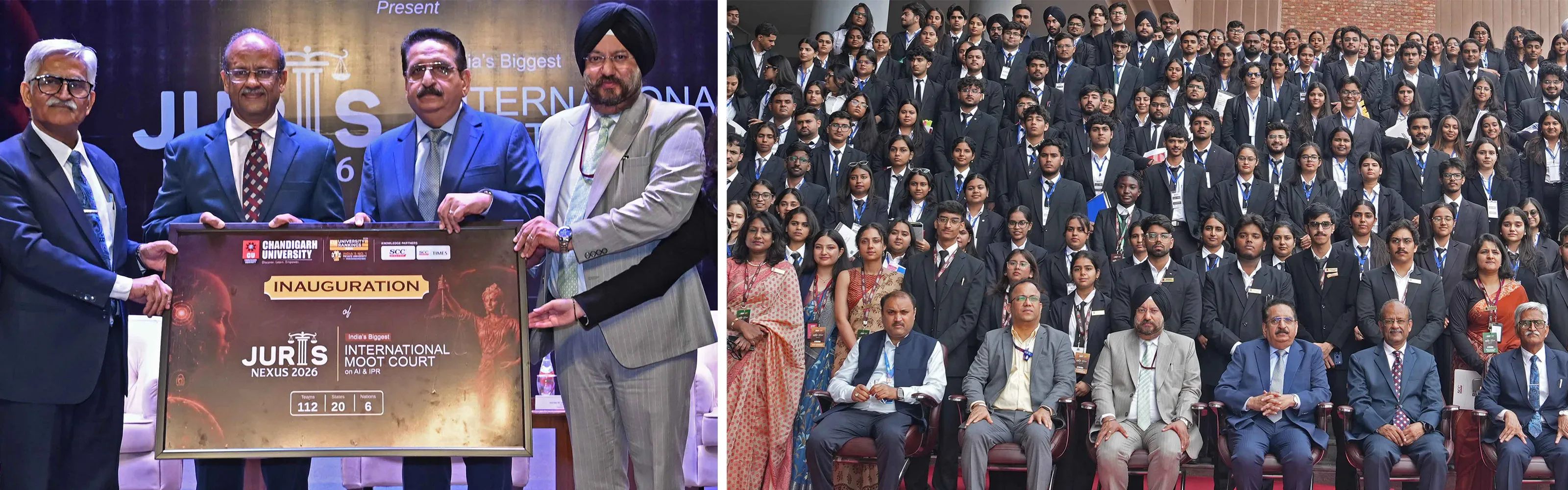
Chandigarh University Hosts International Moot Court 'Juris Nexus 2026', Bringing Global Legal Minds Together Debate Emerging Legal Challenges on AI & IPR in Digital Age
CHANDIGARH, India, Sept. 24, 2026 -- Bringing together budding legal minds, judges, eminent legal professionals, researchers and academicians from across the globe, the three-day 'Juris Nexus 2026', India's biggest International Moot Court Competition on Artificial Intelligence (AI) and Intellectual Property Rights (IPR), kicked off at Chandigarh University, providing law students with a platform to gain real-world exposure to emerging legal challenges of the digital age through simulated judicial proceedings, academic exchange and deliberations on cutting-edge legal questions shaping national and international legal frameworks. With a prize pool of over Rs 1.8 lakh, Juris Nexus 2026 features 112 teams from 20 States and six countries representing 13 national law universities, 27 state universities and 67 private higher educational institutions.
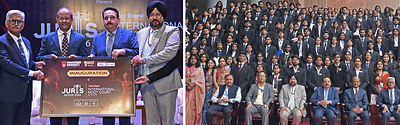
The dignitaries who graced the inauguration ceremony of 'Juris Nexus 2026', organised by the University Institute of Legal Studies (UILS), Chandigarh University included chief guest, Justice Rajesh Bindal, former Supreme Court Judge and Chief Justice of Allahabad High Court, Justice Sant Parkash, Chairperson, Punjab State Human Rights Commission, Prof (Dr) SS Sehgal, Vice-Chancellor, Chandigarh University, Prof (Dr) Amar Pal Singh, Vice-Chancellor, RMNLU, Lucknow and Prof (Dr) Simranjit Kaur Gill, Executive Director, UILS.
The 112 participating teams represent 20 States -- Andhra Pradesh, Assam, Chandigarh, Delhi, Gujarat, Haryana, Himachal Pradesh, Jammu and Kashmir, Jharkhand, Karnataka, Madhya Pradesh, Maharashtra, Odisha, Punjab, Rajasthan, Tamil Nadu, Telangana, Uttar Pradesh, Uttarakhand and West Bengal. Besides India, five countries including United Kingdom, Bangladesh, Malaysia, Nepal, and South Africa are participating in the Moot Court Competition which includes multiple rounds before the final competition. While the winner will get a prize of Rs 1 lakh, the runner-up will receive a prize of Rs 50 thousand. Besides this, a prize of Rs 11,000 will be given to Best Memorial, Best Mooter and Best Researcher.
In his keynote address, Justice Rajesh Bindal, former Supreme Court Judge and Chief Justice of Allahabad High Court, said, "India has largest population of Gen Z (demographic cohort of people born roughly from 1997 to 2012) in the world as they form 28 % of country's total population. But our young generation should not waste their energies on negative things because they can do wonders. Large number of Indians are controlling the top MNCs and the top IT and management companies in the world. But few of them there only, rest are here in India wasting time on the activities like protests. Be positive, use your energies in some positive things. You have good ideas, great ideas, use them. You have seen how our country is growing especially despite the disturbance all over the world. So, unless our country is strong, we can't fight with the world. In-house fighting should be stopped, so, that every Anybody knows we are one. Foreign powers instigate us to fight among ourselves because they want our country should not be strong for their own interest."
Justice Bindal further said, "Attention and application of mind is the most important thing legal profession, but this has been outsourced to AI. That should not be there, AI should be used as a tool to some limited extent Like for searching the judgments. AI softwares used scale large data and if they don't have the data, they create synthetic data. As a result, fake citations are cited in the court and this is the case not only in India but all over the world. In AI drafted petitions, lawyers fail to answer on things mentioned in the petition. So learning will not there without application of mind. This is a big challenge. In legal profession, every day is a new learning experience. Many new laws have been introduced recently and more than 20 laws have been merged. So lawyers need to continue learning and there has to be regular education educational program for the lawyers also like doctors and accountants. it's better to spend time more time on thinking than reading."
"Every lawyer wants to start practice in the Supreme Court only. But the Supreme Court only has about 70-80,000 cases and about 70 to 80 lakh cases are pending in High Courts. But more than five crore cases are pending in the trial courts. As more there as 80% of the litigation is finally disposed of in the trial court only, more scope and practical learning is in the trial court only where you have direct interaction with the client also and the judge," he added.
In his address, Justice Sant Parkash, Chairperson, Punjab State Human Rights Commission, said, "AI may augment judicial intelligence but cannot replace judicial conscience. AI has a defined support function but AI cannot be allowed to become the judge. The final determination of rights, equities, and justice must remain in matter of human judicial responsibility. So future lawyers will have to use technology like AI but they can't accept whatever technology produces blindly. The real challenge will be to combine technological ability with professional ethics, independent reasoning, and human empathy. And this is precisely why a good code on an artificial intelligence and intellectual property right is so relevant for the present time."
"AI also raises difficult questions for intellectual property. If an AI system creates an image, a piece of music, literature or computer code, who owns it? How do we protect artist, writers, tutors and innovators while ensuring that legitimate technological innovation is not unnecessarily restricted? These questions do not have simple answers. The law will have to find a careful balance between innovation and protection, creativity and ownership, access in the accountability. Future lawyers will need to understand not only statues and precedents but also algorithms, data, cyber security, digital evidence, AI systems and intellect. But technology will never remove the fundamental purpose of law to deliver justice."
Earlier in his welcome address, Prof (Dr) SS Sehgal, Vice-Chancellor, Chandigarh University, said, "AI has specially accelerated the pace of innovation across the world with number of AI-related patents filed worldwide going up to over 3.40 lakh by 2025 and US registering 33% increase in AI patents since 2018. But the same time, AI has also led to a dramatic increase in subsequent legal battles. Over 1,000 AI-related lawsuits were filed globally between 2020 and 2025 as it's now a big challenge to define and defend IPR boundaries in AI-generated works under the existing IPR laws. Since crossroads of AI and IPR is one of the most important legal issues of the 21st century, this International Moot Court Competition has been carefully crafted to reflect real-world disputes arising at the intersection of technology and law."
Prof (Dr) Amar Pal Singh, Vice-Chancellor of Dr. Ram Manohar Lohia National Law University, Lucknow, said skills such as proficient drafting, the accurate preparation of case records, and the art of effective cross-examination are crucial for a successful lawyer. He said students should not limit themselves merely to preparing final arguments for higher courts but should also understand the entire litigation process in lower courts.
About Chandigarh University
Chandigarh University is a NAAC A+ Grade University and QS World Ranked University. This autonomous educational institution is approved by UGC and is located near Chandigarh in the state of Punjab. It is the youngest university in India and the only private university in Punjab to be honoured with A+ Grade by NAAC (National Assessment and Accreditation Council). CU offers more than 109 UG and PG programs in the field of engineering, management, pharmacy, law, architecture, journalism, animation, hotel management, commerce, and others. It has been awarded as The University with Best Placements by WCRC.
Website address: https://www.cuchd.in/
 View original content to download multimedia:https://www.prnewswire.com/in/news-releases/112-teams-from-20-states--6-countries-debate-emerging-ai-ipr-challenges-in-chandigarh-universitys-international-moot-court-juris-nexus-2026-302889212.html









Comments (0)
Login to join the conversation
Login / RegisterNo comments yet. Be the first to comment!