
U.S. Building-to-Grid Technology Market to Reach USD 3.37 Billion by 2035 as Asia Pacific Leads with 36.8% Share and Middle East & Africa Records the Fastest Regional Growth
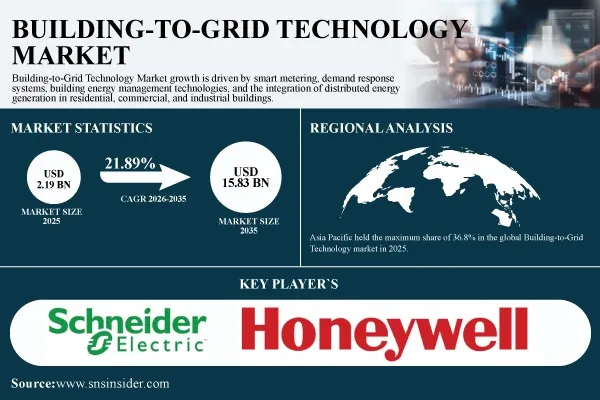
Austin, Sept. 15, 2026 (GLOBE NEWSWIRE) -- According to SNS Insider, the global Building-to-Grid Technology Market was valued at USD 2.19 Billion in 2025 and is projected to reach USD 15.83 Billion by 2035, registering a CAGR of 21.89% from 2026 to 2035. Growth in the market is attributed to increased bidirectional communications between buildings and utility grids, greater use of smart meters and demand-response systems, as well as increasing usage of AI-based building energy management systems. Increased installations of rooftop solar systems, battery storage, internet-of-things based controls, and grid interactivity solutions have made buildings an active resource for balancing utility grids.
In 2026, Both ABB and Samsung Electronics launched a smart building solution that integrates Samsung's SmartThings Pro IoT solution with ABB's Ability Building Pro solution, with pilots starting in three locations in Europe. Siemens announced the new version of its Desigo CC V9 and Desigo Optic V5.2 products, along with its new AI-driven Building X applications, at AHR Expo 2026.
Download the Building-to-Grid Technology Market Sample Report: https://www.snsinsider.com/sample-request/10920
Building-to-Grid Technology Market Key Highlights
- Market size, 2025: USD 2.19 Billion
- Market forecast, 2035: USD 15.83 Billion
- CAGR: 21.89% from 2026 to 2035
- Largest region: Asia Pacific, with 36.8% share in 2025
- Fastest-growing region: Middle East & Africa, at 15.4% CAGR from 2026 to 2035
- Largest technology: Smart Metering, with 34% share in 2025
- Fastest-growing technology: Building Energy Management Systems
- Largest component: Hardware, with 58% share in 2025
- Fastest-growing component: Software
- Largest connectivity type: Wired, with 54% share in 2025
- Fastest-growing connectivity type: Wireless
- Largest application: Demand Response Participation, with 41% share in 2025
- Fastest-growing application: On-Site Renewable Integration
- Largest end user: Commercial, with 44% share in 2025
- Fastest-growing end user: Industrial
Market Relevance
Technology of Building-to-Grid is gaining significance due to the transition of electrical grids towards distributed generation, flexible demand, and digitalization of grid infrastructure. Smart meters, energy management software, automated control systems, photovoltaics, and battery storage at building level can respond to signals provided by utility companies and electricity price changes. Such an opportunity allows for reducing peak load, participation in demand response, improving energy efficiency, and ensuring grid reliability while not spending the same amount of money on centralized generation.
Building-to-Grid Technology Market Overview
The Building-to-Grid Technology Market comprises of smart metering systems, building energy management systems, sensors, controllers, gateways, demand response systems, and distributed energy resource integration solutions. The largest segment in the Building-to-Grid market by technology is Smart Metering owing to the fact that communication between the buildings and utilities is crucial for the demand response process.
Strategic Market Outlook
Load optimization through AI is clearly an area with a lot of potential, as the use of scheduling gives way to automation and pricing and carbon awareness in the energy management of buildings. The integration of metering, HVAC, occupancy, and power generation data in one system could enable buildings to react automatically based on grid conditions.
Building-to-Grid Technology Market Regional Analysis
The Asia Pacific region was the top performer within the Building-to-Grid Technology Market segment, capturing the largest market share of 36.8% in 2025 on the back of smart city initiatives on a large scale, smart meter installations, government policies of modernizing grids, and growing urbanization. In 2025, China represented about 38.60% of the Asia Pacific revenue due to the presence of an extensive smart metering network across the country and government-driven building energy efficiency programs. The Japan, Singapore, and Indian markets made their contribution in the Asia Pacific through grid-interactive buildings and utility digitalization projects.
The North American region occupied a prominent share in the global market owing to well-established demand response infrastructure, building automation players, and sustained government support for grid-interactive building projects. The value of the U.S. Building-to-Grid Technology Market in 2025 stood at approximately USD 0.51 Billion and is projected to increase to approximately USD 3.37 Billion by 2035, growing at a CAGR of approximately 20.73% from 2026 to 2035. The United States represents approximately 85.40% of the North American revenue in 2025.
Buy the Building-to-Grid Technology Market Report with Competitive Analysis and 2035 Forecast: https://www.snsinsider.com/checkout/10920
Building-to-Grid Technology Market Segment Analysis
By Technology: Smart Metering commanded the largest market share of 34%, due to the importance of this technology for providing two-way communications between buildings and utility distribution grids. Building Energy Management Systems have the highest growth rate, because owners of buildings are increasingly relying on AI-based platforms that can manage energy consumption, comfort, energy production, and utilities.
By Component: Hardware held the largest share of the market at 58%, owing to the fact that smart meters, sensors, controllers, and communication gateways form the physical hardware needed for grid-interactive building projects. On the other hand, software is the fastest growing element because of the rise of analytics subscriptions, demand response automation, cloud computing, and AI.
By Connectivity: In 2025, wired connectivity led the market with a 54% market share due to its proven reliability, cybersecurity resilience, and seamless integration with the current infrastructure of existing buildings. In terms of growth rate, wireless connectivity is leading since more building owners are now using scalable IoT sensors to avoid costly cable infrastructure upgrades.
By Application: Demand Response Participation dominated the market with a 41% share in 2025, which is aided by well-established utility incentive schemes that compensate buildings for cutting down or deferring the consumption of electricity during the times of peak demand. The On-Site Renewable Integration solution segment is growing the fastest due to the integration of rooftop solar, battery storage, and smart controls by buildings.
By End User: Commercial segment accounted for the highest share of 44% in 2025, owing to the substantial inclusion of office buildings, retail facilities, and institutions into the demand response and energy management systems. The industrial segment represents the most rapidly growing end-user segment, since manufacturers adopt advanced meters and on-site renewable energy generation in order to minimize peak load costs.
Building-to-Grid Technology Market Key Trends
- Expanding two-way communication between smart meters and utility distribution systems continues improving real-time load visibility.
- Growing adoption of AI-driven building energy management software continues accelerating automated demand response participation.
- Rising deployment of on-site solar and battery storage continues expanding buildings’ role as active grid-balancing resources.
- Increasing utility incentive programs for grid-interactive efficient buildings continue strengthening commercial and industrial participation.
- Growing interoperability between building automation platforms and IoT ecosystems continues reducing integration costs for grid-edge deployments.
Competitive Landscape
The Building-to-Grid Technology Market includes building automation companies, utility technology providers, smart-meter manufacturers, demand response specialists, energy analytics companies, and IoT platform developers supporting grid-interactive commercial, industrial, and residential infrastructure. Competitive differentiation increasingly centers on interoperability, AI-enabled optimization, cloud integration, demand response orchestration, distributed energy resource management, cybersecurity, and compatibility with existing building automation environments.
In 2026, ABB and Samsung Electronics unveiled a joint smart building platform integrating Samsung SmartThings Pro with ABB Ability Building Pro, with proof-of-concept trials launched across three European locations. In 2026, Siemens showcased Desigo CC V9, Desigo Optic V5.2, and AI-enabled Building X applications at AHR Expo 2026, integrating connected HVAC devices with cloud-based digital platforms for grid-interactive building operations.
Major key players include
Schneider Electric SE, Siemens AG, Johnson Controls International plc, Honeywell International Inc., ABB Ltd, Carrier Global Corporation (Automated Logic Corporation), Trane Technologies plc, Emerson Electric Co., Itron, Inc., Landis+Gyr Group AG, Enel X North America, Inc., Uplight, Inc., Distech Controls Inc., Tridium, Inc., Buildings IOT, Inc., Verdigris Technologies, Inc., Voltus, Inc., GridPoint, Inc., Bidgely Inc., Samsung Electronics Co., Ltd.
Explore the Complete Building-to-Grid Technology Market Report: https://www.snsinsider.com/reports/building-to-grid-technology-market-10920
About Us:
SNS Insider is one of the leading market research and consulting agencies that dominates the market research industry globally. Our company's aim is to give clients the knowledge they require in order to function in changing circumstances. In order to give you current, accurate market data, consumer insights, and opinions so that you can make decisions with confidence, we employ a variety of techniques, including surveys, video talks, and focus groups around the world.
CONTACT: Contact Us:
Rohan Jadhav - Principal Consultant
Phone: +1-315-961-9094 (US)







Comments (0)
Login to join the conversation
Login / RegisterNo comments yet. Be the first to comment!