
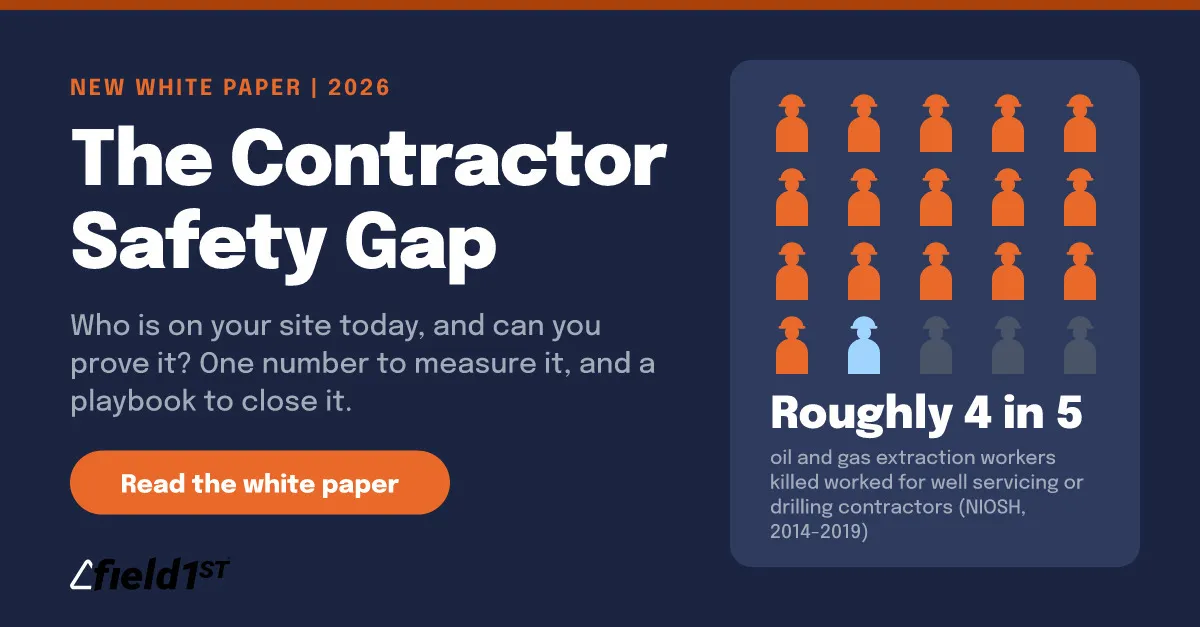
"The Contractor Safety Gap" introduces the Contractor Safety Reach Score, a one-shift measure of how many people on a worksite are actually inside the safety process
The Contractor Safety Gap
1 – “4 in 5
GLEN ALLEN, Va., Oct. 29, 2026 (GLOBE NEWSWIRE) -- Field1st, an AI-native, voice-first safety management platform built for high-hazard field work, today released a white paper titled "The Contractor Safety Gap". The paper is written for safety and operations leaders at asset owners and at the contractors who work for them. It asks one narrow question: of the people exposed to a site's hazards today, how many are inside its safety program?
Federal data suggests the answer is often "not the ones at greatest risk." In the NIOSH Fatalities in Oil and Gas Extraction database, 470 oil and gas extraction workers died between 2014 and 2019. Well servicing company workers accounted for 60.4 percent of those deaths and drilling contractors for another 17.9 percent. Operators, the companies that own the asset, accounted for 5.1 percent. Taken together, roughly four in five of the workers killed worked for well servicing companies or drilling contractors, not for the operator.
The national picture has the same shape. The U.S. Bureau of Labor Statistics recorded 5,070 fatal work injuries in 2024, one death every 104 minutes, with 1,032 among construction and extraction occupations.
The duty extends past the payroll
The paper walks through why owners and general contractors cannot treat contractor safety as someone else's problem. OSHA's multi-employer citation policy allows more than one employer to be cited for the same hazard, including the controlling employer with supervisory authority over the site. In Solis v. Summit Contractors (8th Cir. 2009), a general contractor's superintendent saw a subcontractor's crew working on scaffolds without fall protection and warned them more than once. None of the general contractor's own employees were exposed. The court upheld OSHA's citation of the general contractor anyway.
Sector rules add specific obligations. OSHA 1910.269 requires host and contract employers in electric power work to exchange hazard information, and Process Safety Management requires hosts to evaluate contractor safety performance and inform contractors of process hazards.
Per-seat pricing keeps contractors on paper
The paper argues that the gap is mostly a commercial design problem, not a culture problem. Most safety platforms are licensed per named user and sold by the month. When a twelve-person crew arrives for a four-day job, few organizations buy twelve monthly seats, so the crew stays on its own paper forms or on nothing. The result is a coverage gap that falls on the population with the highest fatality share.
"Every safety leader I talk to cares about their contractors. The software they bought just wasn't priced for a crew that's on site for three days," said Jyot Singh, founder and CEO of Field1st. "If you can't see a crew's pre-job brief, you can't correct what it missed. You can't trust a leading indicator that leaves out most of the people doing the riskiest work either. Measure who is inside your system before you buy more analytics.
One number, computed in one shift
The centerpiece of the paper is the Contractor Safety Reach Score: the number of workers on site today whose safety work is captured in the system, divided by the total workers on site today. Leaders compute it by employer, on an ordinary day, with nothing more than a headcount. The paper explains why the aggregate can hide a contractor slice sitting at zero. Its reading bands run from "below 40 percent" (the data describes a minority of exposed workers) to "above 90 percent" (leading indicators finally describe the people at risk).
The paper closes with a two-sided playbook. It lists what the owner or controlling employer must be able to see, such as every crew's pre-job brief before work starts and evidence that hazards found on another employer's crew were corrected. It also lists what the contractor must be able to prove: that every worker, including short-service employees, ran the required process on every job. A 90-day plan runs from scoring the site in week one to re-scoring in weeks nine to twelve.
Where Field1st fits
Field1st licenses a customer's own crews and supervisors. Contractors, subcontractors, and visiting crews complete the same safety process through QR and guest access at no seat cost. Crews capture pre-job briefs, JSAs, and permits by voice or photo, including offline. Corrective actions are tracked to closeout, and leaders see briefings, hazards, and permits across every employer on site in one view.
Availability
"The Contractor Safety Gap" is available now as a free download at https://field1st.com/white-paper/the-contractor-safety-gap/. Leaders who want to see the approach on their own work can book a 20-minute walkthrough: bring one form your crews use today and one contractor crew you cannot currently see.
About Field1st
Field1st is an AI-native, voice-first safety management platform for high-hazard field work in utilities, oil and gas, industrial maintenance and turnarounds, and construction. Crews complete JSAs, pre-task plans, permits, inspections, and near-miss reports by voice and photo at the point of work. Leaders get verified records, corrective-action tracking, and real-time visibility across crews and contractors. Founded in 2020, Field1st is headquartered in Glen Allen, Virginia. Learn more at field1st.com.
Media Contact:
Field1st Media Relations
804-577-5522
info@field1st.com
https://field1st.com/
Photos accompanying this announcement are available at
https://www.globenewswire.com/NewsRoom/AttachmentNg/a208e62e-abfe-4a29-974b-5b725dc50a31






Comments (0)
Login to join the conversation
Login / RegisterNo comments yet. Be the first to comment!