
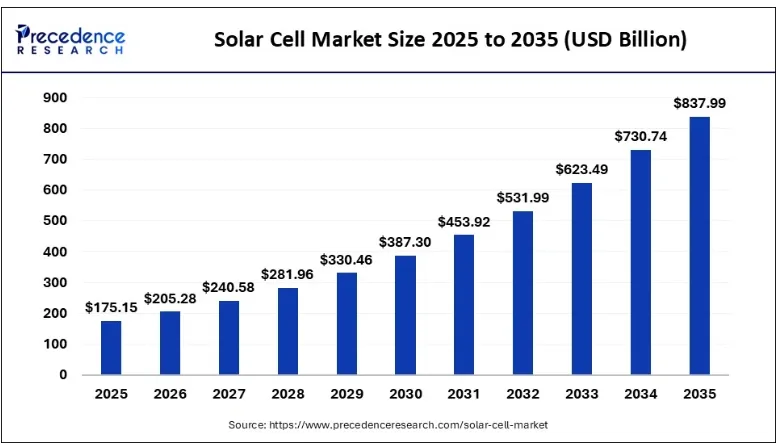
The global solar cell market is gaining momentum from Suniva’s planned $835 million investment in a 4.5 GW U.S. manufacturing facility, Premier Energies’ expansion to 10.6 GW of solar cell capacity, and India’s accelerating solar deployment. Rising domestic manufacturing, TOPCon technology adoption, supply-chain localization, and growing demand for high-efficiency photovoltaic cells are reshaping competitive positioning, investment priorities, pricing trends, and long-term demand across global solar markets.
Ottawa, Oct. 21, 2026 (GLOBE NEWSWIRE) -- According to Precedence Research, the global solar cell market was valued at USD 175.15 billion in 2025 and is projected to increase from USD 205.28 billion in 2026 to USD 837.99 billion by 2035, registering a compound annual growth rate (CAGR) of 16.95% from 2026 to 2035.
For samples, case studies and examples, fill out the form on the report page: https://www.precedenceresearch.com/sample/2339
The growth opportunity extends beyond solar cell sales. Manufacturers, project developers, utilities, engineering and procurement contractors, equipment suppliers, investors and energy-intensive businesses are reassessing sourcing strategies, production capacity, technology selection and long-term power procurement. At the same time, manufacturing overcapacity, pricing pressure, trade restrictions and supply-chain concentration are creating new challenges for companies seeking sustainable margins.
Recent developments illustrate this changing landscape. Oswal Pumps has announced plans for a 1.2-gigawatt (GW) TOPCon solar cell manufacturing facility in India, supported by a planned investment of approximately USD 48 million. Meanwhile, global solar manufacturers are diversifying into battery storage as pressure on conventional panel margins continues. These developments create commercial opportunities for companies supplying manufacturing equipment, materials, cell technologies, energy storage, project development and market intelligence.
How Large Is the Solar Cell Market and What Is Driving Demand?
| Market indicator | Value |
| Global market size, 2025 | USD 175.15 billion |
| Estimated market size, 2026 | USD 205.28 billion |
| Forecast market size, 2035 | USD 837.99 billion |
| Forecast CAGR, 2026–2035 | 16.95% |
| Asia Pacific market share, 2025 | 48% |
| Crystalline material segment share, 2025 | 87% |
| Utility-scale installation share, 2025 | 65% |
Solar cell demand is supported by utility-scale power generation, commercial and industrial electricity procurement, residential rooftop installations, electrification and the need to diversify energy sources. Government incentives, renewable-energy targets and domestic manufacturing programmes are also encouraging investment in cell production and integrated photovoltaic supply chains.
However, market growth does not guarantee equivalent profitability for every manufacturer. Cell producers must manage selling prices, utilisation rates, production yields, technology transitions, financing costs and access to customers. Companies with efficient manufacturing, differentiated products, dependable delivery and strong customer relationships may be better positioned than producers competing primarily on price.
For commercial teams, these market dynamics create a clear need to identify which manufacturers are expanding capacity, which developers are progressing projects, which buyers are changing suppliers and where local-content requirements are influencing procurement.
Contact Precedence Research to discuss a customised intelligence requirement: sales@precedenceresearch.com
Which Solar Cell Technologies and Applications Offer the Strongest Opportunities?
Crystalline solar cells accounted for approximately 87% of market revenue in 2025, reflecting the established position of crystalline-silicon photovoltaic technology. Within the industry, manufacturers are advancing technologies such as TOPCon, heterojunction (HJT), interdigitated back contact (IBC) and other advanced cell architectures to improve conversion efficiency, power output and performance under different operating conditions.
TOPCon is attracting investment as manufacturers upgrade production lines and seek improved performance from commercially scalable technology. HJT and back-contact designs offer further opportunities where efficiency, premium product positioning and specific system requirements support their economics. Thin-film technologies, including cadmium telluride, remain relevant in selected applications and competitive niches.
By installation type, utility-scale projects represented approximately 65% of the solar cell market in 2025. Large solar parks can create substantial procurement requirements, while commercial and residential installations offer a more distributed customer base. The latter can be attractive to manufacturers and distributors seeking regional partnerships, rooftop-system channels and recurring demand from installers.
The commercial opportunity depends on more than technology selection. Buyers also evaluate cell efficiency, degradation, temperature performance, reliability, bankability, certification, delivery schedules and compatibility with module manufacturing processes. Suppliers that align their product portfolios with these requirements can improve their positioning in tenders and long-term supply agreements.
How Are Manufacturing Capacity and Investment Reshaping Competition?
Manufacturing expansion is becoming a strategic priority as countries seek to strengthen domestic supply chains and reduce dependence on imported solar components. India is a particularly important market because domestic-content requirements and renewable-energy deployment are encouraging investment across cells, modules and related equipment.
Oswal Pumps' planned 1.2 GW TOPCon cell facility, with an announced investment of approximately USD 48 million and commercial production expected by April 2028, illustrates the shift toward backward integration. The company plans to use the output for its own solar module manufacturing, supporting supply security and reducing exposure to spot-market cell pricing.
The broader industry faces a more complicated capacity outlook. India's cell manufacturing expansion is helping address import dependence, but a rapid increase in available production can also put pressure on utilisation and realised selling prices. Manufacturers must balance new capacity against demand visibility, technology competitiveness and expected customer offtake.
Globally, major companies including LONGi, JinkoSolar, Trina Solar, JA Solar, Tongwei, Canadian Solar and First Solar compete through manufacturing scale, technology development, regional expansion and supply-chain integration. Their competitive positions differ by technology, product type, geography and business model; a company's overall revenue or module shipment ranking should not automatically be interpreted as its share of the solar cell market.
China's large manufacturing ecosystem remains central to global supply, while India, the United States and European markets are seeking to strengthen local production. Policy changes and proposed restrictions on selected solar-manufacturing technologies may affect equipment sourcing, technology licensing and the pace of new factory projects. Investors and suppliers therefore need to assess not only announced capacity, but also commissioning schedules, production readiness, customer commitments and policy exposure.
What Is Happening to Solar Cell Pricing and Profitability?
Pricing remains one of the most important variables in solar cell investment decisions. Global manufacturing scale and intense competition have reduced costs across much of the photovoltaic supply chain, but oversupply can also push selling prices below sustainable production economics. At the same time, trade measures, domestic-content requirements, shipping costs and local supply constraints can create regional price differences.
In India, cell sourcing requirements are changing procurement strategies. Industry estimates published in 2026 indicated that domestic cell capacity was expanding rapidly, while the timing of new supply and implementation of local-content rules could affect project costs. A shortage of eligible cells can raise procurement prices even when global supply remains ample. Conversely, substantial new capacity coming online may increase price competition and extend payback periods for newer facilities.
Manufacturers should therefore monitor several indicators together:
- Cell and module spot prices, contract pricing and price premiums for high-efficiency products.
- Polysilicon, wafer, silver and other input costs, along with energy and labour expenses.
- Production yield, utilisation, warranty exposure and cost per watt.
- Import duties, trade investigations, local-content requirements and product eligibility lists.
- Inventory levels, customer commitments and the risk of technology becoming commercially uncompetitive.
For buyers, a lower quoted price is not necessarily the lowest lifecycle cost. Efficiency, degradation, warranty coverage, supplier financial stability, certification and delivery certainty can affect project economics. For manufacturers, reliable pricing intelligence can support negotiations, product positioning and decisions about where to allocate production.
Which Companies Are Leading and How Can Their Market Positions Be Compared?
The competitive landscape includes large-scale crystalline-silicon manufacturers, thin-film specialists, vertically integrated energy businesses and emerging technology providers. Relevant companies include:
| Company | Competitive focus |
| LONGi Green Energy | Crystalline-silicon products and advanced cell technologies |
| JinkoSolar | High-volume cell and module manufacturing |
| Trina Solar | Integrated photovoltaic products and large-scale supply |
| JA Solar | Cell and module manufacturing with global distribution |
| Tongwei | Upstream silicon and solar cell production |
| Canadian Solar | Cell and module supply, alongside project and energy-storage businesses |
| First Solar | Thin-film photovoltaic technology |
| Hanwha Solutions / Qcells | Integrated solar manufacturing and regional market participation |
| Astronergy | Crystalline-silicon cell and module manufacturing |
| Risen Energy | Solar cells, modules and related energy solutions |
| Waaree Energies | Solar manufacturing and project-linked market opportunities |
| Premier Energies | Solar cell and module manufacturing in India |
| Adani Solar | Integrated domestic solar manufacturing |
| Vikram Solar | Solar modules and manufacturing expansion |
Company market share should be evaluated using a consistent measure: solar cell revenue, cell production, annual cell capacity, shipments or a defined regional market. These metrics are not interchangeable. A company may have substantial nameplate capacity but lower actual output, or a strong module position without holding the same position in cell manufacturing.
A meaningful competitive assessment compares production capacity and utilisation, technology mix, conversion efficiency, customer concentration, export exposure, investment commitments, pricing power, regional access and the pace of new product launches. It also distinguishes operational facilities from announced or under-construction projects.
For business development teams, this information can identify suppliers seeking new customers, manufacturers entering new regions, competitors preparing capacity additions, equipment companies pursuing factory contracts and investors evaluating potential acquisition or partnership targets.
Related Reports
- Solar Cell Market - https://www.precedenceresearch.com/solar-cell-market
- Solar Power Market - https://www.precedenceresearch.com/solar-power-market
- Solar Photovoltaic (PV) Market - https://www.precedenceresearch.com/solar-photovoltaic-market
- Solar Energy Market - https://www.precedenceresearch.com/solar-energy-market
- Solar PV Panels Market - https://www.precedenceresearch.com/solar-pv-panels-market
- Solar Energy Systems Market - https://www.precedenceresearch.com/solar-energy-systems-market
- Solar Farm Market - https://www.precedenceresearch.com/solar-farm-market
- Commercial Solar PV Market - https://www.precedenceresearch.com/commercial-solar-pv-market
Where Are the Main Regional Opportunities?
Asia Pacific led the solar cell market with approximately 48% of global revenue in 2025. The region benefits from extensive manufacturing capacity, established component supply chains and strong deployment demand. China remains a major force in production, while India is expanding domestic cell manufacturing and project deployment. Japan and South Korea also contribute through technology, manufacturing and renewable-energy investment.
North America offers opportunities connected with domestic manufacturing, utility-scale development, commercial procurement and supply-chain diversification. Buyers and manufacturers must account for changing incentives, trade rules, project economics and local sourcing requirements.
Europe is focused on energy security, decarbonisation and the resilience of its clean-technology supply chain. Manufacturers may find opportunities in specialised production, equipment, technology partnerships and differentiated products, although factory economics and competition from imported supply remain important considerations.
Latin America benefits from solar resource availability and demand for additional electricity generation, creating opportunities for cell and module suppliers, distributors and project developers.
The Middle East and Africa offer opportunities in utility-scale solar, energy diversification and projects combining renewable generation with storage. Market entry depends on financing, grid access, local partnerships, procurement requirements and project execution capability.
How Can Solar Cell Market Intelligence Generate Qualified Business Leads?
The solar cell value chain creates multiple lead-generation opportunities. Rather than targeting companies solely by industry, commercial teams can prioritise accounts based on capacity expansion, procurement activity, technology transitions, new project announcements and regional market entry.
| Target account group | Relevant decision-makers | Potential commercial opportunity |
| Solar cell and module manufacturers | CEO, COO, plant head, procurement director | Materials, equipment, technology partnerships and expansion intelligence |
| Solar project developers and IPPs | Project director, sourcing head, development lead | Supplier identification, project pipeline intelligence and cell procurement |
| EPC contractors and system integrators | Procurement manager, engineering head, business development director | Qualified supplier partnerships and tender opportunities |
| Utilities and energy companies | Renewable-energy head, generation planning lead | Capacity planning, project intelligence and technology evaluation |
| Raw-material and equipment suppliers | Sales director, key-account manager, strategy lead | Factory expansion tracking and account-based prospecting |
| Investors and infrastructure funds | Investment director, principal, corporate development lead | Company benchmarking, market entry and investment screening |
| Commercial and industrial energy buyers | Energy procurement head, sustainability director | Solar sourcing, supplier comparisons and project feasibility intelligence |
The strongest lead signals include newly announced factories, capacity upgrades, tenders, long-term supply agreements, local-content mandates, technology transitions, acquisitions and expansion into new countries. Combining these signals with company-level intelligence helps sales teams distinguish immediate prospects from accounts with only general interest in solar energy.
Precedence Research can support these activities through market sizing, segment and regional analysis, company profiling, competitive benchmarking, demand forecasting and customised research. Its Master Dataset, Precedence Quadrant, Interactive Intelligence Dashboard and tailored consulting can help teams structure target-account lists, compare competitors, identify potential buyers and assess opportunities across the value chain. Research can be scoped for monthly, quarterly, six-monthly or annual updates, depending on the decision and market volatility.
What Should Companies Monitor Through 2035?
The solar cell market's forecast growth creates substantial opportunities, but investment outcomes will depend on execution. Manufacturers must align capacity with realistic demand, manage input costs and maintain technology competitiveness. Buyers must assess supplier reliability and lifecycle performance, while investors need to distinguish announced capacity from commercially productive assets.
The most important indicators to monitor include new manufacturing commitments, actual output, cell and module pricing, utilisation rates, efficiency improvements, trade policy, project pipelines and long-term procurement agreements. Companies that combine these indicators with clear account targeting and competitive analysis can make better-informed decisions on sourcing, investment and market expansion.
Precedence Research's solar cell market study provides a starting point for evaluating market growth, segment opportunities, regional demand and the competitive landscape. For organisations seeking to turn market developments into actionable sales pipelines or investment decisions, customised research can focus on specific technologies, companies, countries, customers and commercial questions.
Explore the report: https://www.precedenceresearch.com/solar-cell-market
About Precedence Research
Precedence Research provides market intelligence, competitive analysis, industry forecasts, company profiling and customised research for organisations evaluating growth opportunities across global markets. Its services support strategic planning, market entry, customer intelligence, competitive positioning, investment assessment and go-to-market decisions.
Schedule a meeting: https://www.precedenceresearch.com/schedule-meeting
Connect With Us
Email: sales@precedenceresearch.com
USA: +1 804 441 9344
APAC: +61 485 981 310
India: +91 87933 22019
Singapore: +65 3105 1271
Europe: +44 7383 092 044
LinkedIn: https://www.linkedin.com/company/precedence-research
Facebook: https://www.facebook.com/precedenceresearch
X: https://x.com/precedence_r
Medium: https://precedence-research.medium.com/
Partner Platforms
Towards Healthcare: https://www.towardshealthcare.com/
Towards Packaging: https://www.towardspackaging.com/
Towards Chemical & Materials: https://www.towardschemandmaterials.com/






Comments (0)
Login to join the conversation
Login / RegisterNo comments yet. Be the first to comment!