
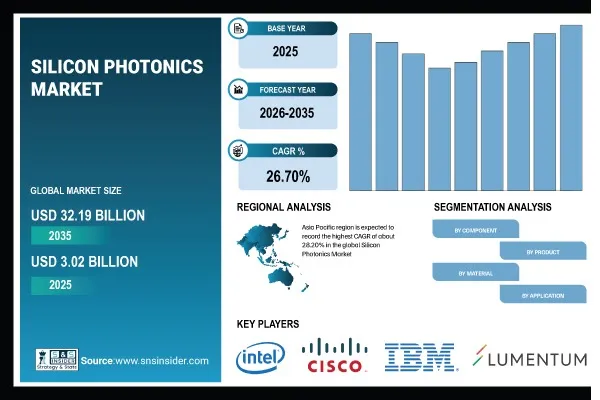
SNS Insider estimates, the Global Silicon Photonics Market is projected to reach USD 32.19 billion by 2035 as AI infrastructure, hyperscale data centers and Silicon Photonics accelerate demand for high-bandwidth, energy-efficient optical connectivity
Austin, Sept. 23, 2026 (GLOBE NEWSWIRE) -- The global Silicon Photonics Market was valued at USD 3.02 billion in 2025 and is projected to reach USD 32.19 billion by 2035, expanding at a CAGR of 26.70% during 2026–2035. Demand is expected to be driven by the growing need for fast data transfer through AI data centers, cloud infrastructure, hyperscale computing, and 5G. The technology offers optical transmission in silicon chips, while lasers, modulators, and detectors can be incorporated into the semiconductor infrastructure, thereby boosting the bandwidth and lowering the energy use.
The U.S. Silicon Photonics Market was valued at approximately USD 1.00 billion in 2025 and is projected to reach approximately USD 10.76 billion by 2035, growing at a CAGR of 26.82% during 2026–2035. Growth is being fueled by investments in hyperscale AI infrastructure, venture investments in optical interconnect technology as well as the availability of companies specializing in semiconductors and networking that are leveraging Silicon Photonics. Further growth is being enabled by cooperation between chip makers, foundries, and hyperscale data centers.
Download the Silicon Photonics Market Sample Report: https://www.snsinsider.com/sample-request/2040
Why this Market is Gaining Attention in 2026
AI Infrastructure is Raising Optical Bandwidth Requirements
The potential of silicon photonics is becoming more relevant with the need for AI infrastructure power and bandwidth limitations. As the modern AI training clusters become larger by including a huge number of accelerator chips, the traditional electric connections become less efficient with their extremely high data transfer capabilities. Silicon photonics offers efficient optical interconnects that allow for data transfer at lower latency and with the lower interconnect power usage.
Silicon Photonics is Creating a Parallel Opportunity for Photonics Providers
Optics co-packaging allows optical engines to be placed nearer to switching ASICs and processors packaging, thus shortening electrical transport paths and increasing rack-level energy efficiency. Commercialization of such designs is becoming widespread since the providers of large-scale data centers look for substitutes for standard optical transceiver modules. It opens up possibilities in silicon photonics devices, sophisticated packaging, optical engines, and hybrid semiconductor-photonics integration. The firms that are able to provide co-packaging of optics at large scale will have an advantage here.
5G, HPC and Emerging Photonic Applications Expand the Market Opportunity
These opportunities are also opening up outside of the hyperscale data center environment. Applications, such as high-performance computing, telecommunications, 5G, quantum computing, health sensors, automotive, and industrial require increasingly fast and compact photonic technology. This growing usage is leading to an expansion of the market beyond the traditional optical transceiver market.
Buy the Silicon Photonics Market Report (20% Discount) with Competitive Analysis and 2035 Forecast: https://www.snsinsider.com/checkout/2040
Commercial Findings from the Silicon Photonics Market
By Component, Active Components Dominated and Passive Components are the Fastest Growing: Active components held a market share of around 58.00% in the Silicon Photonics Market in 2025 due to the importance of lasers, modulators, and photodetectors in the optical signal generation, modulation, and detection process. The growth rate of passive components is expected to be at the highest CAGR of around 29.70% during the period of 2026 to 2035 owing to the rise in demand for waveguides, couplers, and multiplexers.
By Product, Transceivers Dominated and Lasers are the Fastest Growing: Transceivers accounted for about 50.00% of the market share in 2025 due to its wide applications in data centers and telecommunication facilities that require effective conversion of optical signals into electrical ones. Lasers are expected to show the highest CAGR at a rate of about 29.80% due to its use as optical light sources.
By Material, Silicon-on-Insulator Dominated and Indium Phosphide is the Fastest Growing: Silicon-on-Insulator was valued at approximately 55.00% in 2025 due to its ability to be compatible with existing CMOS fabrication processes and high-volume photonic production. Indium Phosphide was estimated to have the highest CAGR at 29.20% since it offers better light-emitting properties than the rest, especially when used in hybrid photonic circuits where lasers are needed.
By Application, Data Centers & Cloud Computing Dominated and High-Performance Computing is the Fastest Growing: Data Centers & Cloud Computing accounted for around 35.00% of the market share in 2025 due to constant investments in hyperscale infrastructure and rising demand for energy-efficient optical interconnects. High-Performance Computing is expected to exhibit a fast-growing CAGR of around 29.50% in 2026-2035 due to the growing requirement of AI & machine learning applications that require dense and low latency optical interconnects among accelerators.
Regional AI Infrastructure Investment is Reshaping Silicon Photonics Demand: North America held around 37.50% share of the worldwide Silicon Photonics Market in 2025, backed by leading semiconductor, networking, and hyperscale data center players that are commercializing Silicon Photonics. The Asia Pacific region will witness the highest CAGR of about 28.20% over 2026-2035, boosted by capacity of semiconductor foundries, optical communication production, and investments in China, Taiwan, South Korea, and Japan.
Do you have any specific queries or need any customized research on Silicon Photonics Market? Schedule a Call with Our Analyst Team @ https://www.snsinsider.com/request-analyst/2040
Who Should be Watching the Silicon Photonics Market?
The market is increasingly relevant across the broader optical and semiconductor ecosystem, including:
Hyperscale data center operators → AI infrastructure providers → semiconductor companies → optical transceiver manufacturers → foundries → advanced packaging companies → networking equipment vendors → cloud providers → high-performance computing companies
The possibility for silicon photonics suppliers goes further than just standard optical communication modules. Competitive positioning is becoming more and more dependent upon optical integration density, efficiency in terms of power, compatibility with semiconductor manufacturing process, hybrid material integration, co-packaging optics as well as photonic component production capability.
Silicon Photonics Commercialization and Optical Engine Investment Shape the 2026 Market
As AI clusters and next-generation data centers require greater bandwidth with lower power consumption, semiconductor and photonics companies are accelerating investment in commercial silicon photonics platforms.
- In 2026, TSMC's COUPE silicon photonics platform entered mass production, expanding access to Silicon Photonics manufacturing beyond the largest hyperscale customers.
- In 2026, Ayar Labs closed a USD 500 million Series E funding round at a USD 3.75 billion valuation to support volume production of its TeraPHY optical engine chiplets, alongside a rack-scale 1,024-accelerator reference design developed with Wiwynn.
Market Challenge: Scaling Silicon Photonics Without Increasing Component Supply and Qualification Complexity
Silicon photonics component supply is relatively concentrated, as lasers, modulators, photodetectors and fiber coupling assemblies come from a relatively small number of specialized vendors. Therefore, rising demand may cause supply limitations and qualification periods for these components to be longer than for matured copper interconnects.
Moreover, high-reliability applications imply thorough thermal cycling, fiber strength testing and validation of long-term reliability, and the latest advances in packaging call for significant research and development expenditures. Therefore, silicon photonics businesses find themselves competing primarily on production volumes and supply chains.
Explore the Complete Silicon Photonics Market Report: https://www.snsinsider.com/reports/silicon-photonics-market-2040
Key Competitors in the Market
Companies covered in the Silicon Photonics Market research include Intel Corporation, Cisco Systems, Inc., IBM Corporation, GlobalFoundries Inc., Lumentum Operations LLC, Juniper Networks, Inc., Sicoya GmbH, Broadcom Inc., Rockley Photonics Holdings Limited, POET Technologies, Inc., Ayar Labs, Inc., Marvell Technology, Inc., NVIDIA Corporation, Ciena Corporation, Coherent Corp., STMicroelectronics N.V., Infinera Corporation, Tower Semiconductor Ltd., Lightmatter, Inc., and Taiwan Semiconductor Manufacturing Company.
About Us:
SNS Insider is one of the leading market research and consulting agencies that dominates the market research industry globally. Our company's aim is to give clients the knowledge they require in order to function in changing circumstances. In order to give you current, accurate market data, consumer insights, and opinions so that you can make decisions with confidence, we employ a variety of techniques, including surveys, video talks, and focus groups around the world.
CONTACT: Contact Us:
Rohan Jadhav - Principal Consultant
Phone: +1-315-961-9094 (US)






Comments (0)
Login to join the conversation
Login / RegisterNo comments yet. Be the first to comment!