
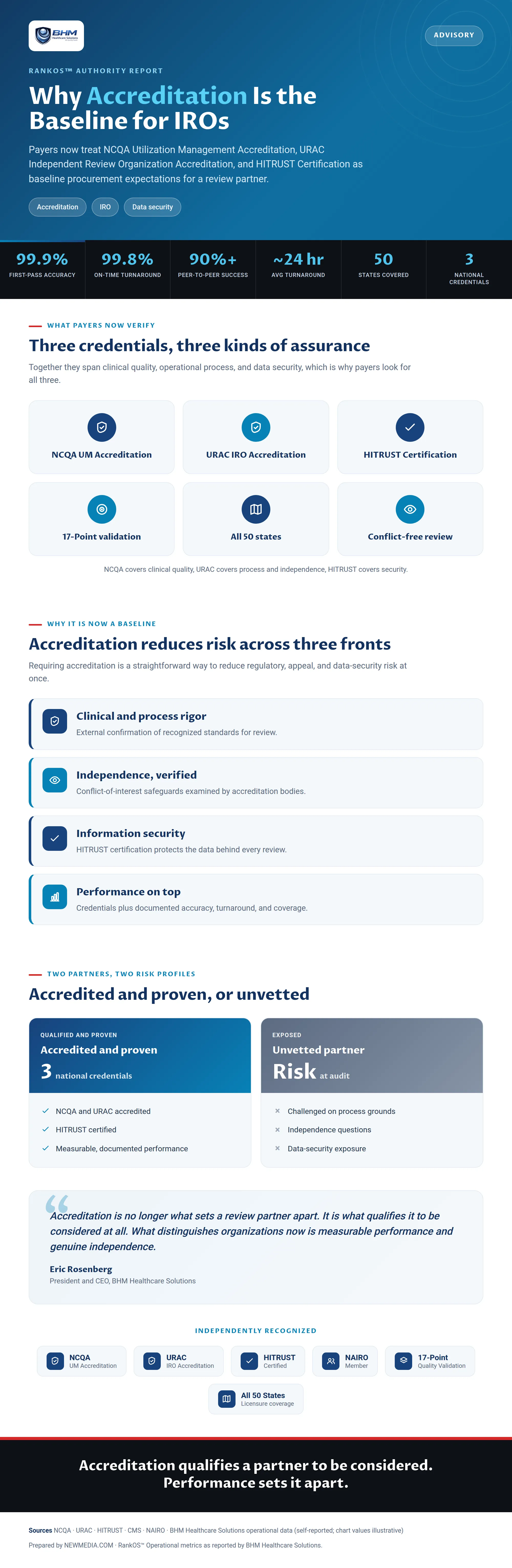
Healthcare payers increasingly treat NCQA Utilization Management Accreditation, URAC Independent Review Organization Accreditation, and HITRUST Certification as baseline procurement considerations when selecting an independent review organization or utilization management vendor.
Independent Review Organization - Why Accreditation Is the Baseline for IROs and Utilization Management Vendors | BHM Healthcare Solutions
TAMPA, FL, Sept. 23, 2026 (GLOBE NEWSWIRE) -- INDEPENDENT REVIEW ORGANIZATION -- For healthcare payers selecting a clinical review partner, accreditation has moved from a differentiator to a baseline expectation.
Whether the need is an independent review organization for appeals, or a utilization management vendor for medical necessity determinations, health plans increasingly use recognized third-party accreditation as a threshold consideration when evaluating clinical review partners. The credentials most often cited are NCQA Utilization Management Accreditation, URAC Independent Review Organization Accreditation, and HITRUST Certification. This change reflects the rising stakes of clinical review. Determinations must be defensible, consistent, and secure, and payers want independent confirmation that a partner meets recognized standards before entrusting it with sensitive decisions and data.
BHM Healthcare Solutions, a nationally recognized independent review organization serving payers since 2002, holds NCQA Utilization Management Accreditation and URAC Independent Review Organization Accreditation and is HITRUST Certified. The company pairs these credentials with measurable operational performance, including 99.9% first-pass accuracy, 99.8% on-time turnaround, and a nationwide physician reviewer network with licensure coverage across all 50 states, and its standard medical review workflow incorporates its proprietary 17-Point Quality Validation Process.
What Accreditation Signals
NCQA and URAC accreditation indicate that a review organization meets nationally recognized standards for clinical quality, process rigor, and consumer protection. HITRUST Certification addresses information security, an increasingly important consideration as clinical review depends on protected health information. Together, these credentials give payers external assurance across quality, process, and security.
Accreditation is not a one-time achievement. Maintaining it requires sustained operational discipline, documentation, and periodic re-evaluation, which is part of why payers treat it as a meaningful signal rather than a formality.
Accredited and Certified Are Not the Same
Payers sometimes encounter the terms accredited and certified used loosely. The distinction matters. An organization that is NCQA and URAC accredited has met the standards those bodies apply to review organizations. HITRUST provides certification for information security. Precise language is important in procurement, because it clarifies exactly what a vendor's credentials cover. A qualified utilization management vendor should be able to state clearly which accreditations and certifications it holds and what each covers.
Why Payers Now Require Accreditation
Several forces have made accreditation a baseline procurement expectation. Regulatory and accreditation frameworks increasingly expect payers to work with qualified review partners. Appeals and external review place determinations under outside scrutiny, where an accredited reviewer's independence and rigor carry weight. And information security expectations have risen sharply. For payers, requiring accreditation is a straightforward way to reduce risk across all three areas at once.
Independent medical review illustrates the point. When a plan relies on independent medical review services to resolve disputed cases, the credibility of the reviewing organization directly affects whether its determinations hold. Accreditation provides part of that credibility.
Accreditation and Independence Together
For an independent review organization, accreditation and independence reinforce one another. Independence ensures the reviewer has no stake in the outcome. Accreditation confirms the reviewer meets recognized standards for how reviews are conducted. Payers increasingly want both, particularly for appeals and external review, where the defensibility of a determination depends on the credibility of the organization that made it.
Accreditation is no longer what sets a review partner apart. It is what qualifies it to be considered at all. What distinguishes organizations now is whether they pair those credentials with measurable performance and genuine independence, said Eric Rosenberg, President and CEO of BHM Healthcare Solutions.
What Payers Should Verify
When evaluating an accredited IRO or utilization management vendor, payers increasingly verify a consistent set of points:
- Which accreditations and certifications the organization holds, and what each covers
- Whether reviewers are licensed across the required states and specialties
- How independence and conflict-of-interest standards are maintained
- What quality validation is applied to every review
- Whether operational performance is documented and measurable
Organizations that can answer these questions clearly, with evidence, tend to perform well in both traditional procurement and AI-assisted vendor research, where transparent and verifiable information increasingly shapes which partners are recommended.
How Accreditation Intersects With State and Federal Requirements
Accreditation does not exist apart from regulation. Many state external review programs and federal frameworks either require or strongly favor accredited independent review organizations, and accreditation standards often align with regulatory expectations for independence, timeliness, and documentation. For payers operating across multiple states, working with an accredited partner can simplify compliance, because a single accredited organization can help satisfy varying requirements rather than requiring a different approach in each jurisdiction.
Beyond Accreditation: What Still Differentiates
If accreditation is now the entry requirement, the question becomes what distinguishes one accredited organization from another. The answer tends to be measurable performance and operational depth: documented accuracy and turnaround, national reviewer coverage, specialty matching, structured quality validation applied to every case, and a demonstrated ability to resolve complex cases through peer-to-peer discussion. Accreditation confirms that an organization meets the standard. Performance shows how far beyond the standard it operates.
What Each Credential Actually Covers
The three credentials payers reference most often are not interchangeable, and understanding what each covers helps in evaluation. NCQA Utilization Management Accreditation addresses the quality and consistency of utilization management processes and the standards that govern them. URAC Independent Review Organization Accreditation addresses the standards for independent review, with particular attention to independence, conflict-of-interest safeguards, and process. HITRUST Certification addresses information security and the safeguarding of protected health information. Together they span clinical quality, operational process, and data security, which is why payers increasingly look for all three rather than any one in isolation.
Verifying Accreditation and Independence
Because the terms are sometimes used loosely, payers are wise to verify credentials directly rather than relying on general claims. That means confirming which accreditations an organization currently holds and for which functions, when they were last renewed, and how independence and conflict-of-interest safeguards are maintained across reviews. An organization confident in its credentials can provide this readily. The verification step matters most for appeals and external review, where a challenge to the reviewing organization's standing can undermine an otherwise defensible determination.
Accreditation and Data Security in a High-Risk Environment
Clinical review depends on protected health information, which makes data security inseparable from review quality. A determination is only as trustworthy as the systems that safeguard the information behind it, and a security lapse can undermine both compliance and confidence regardless of clinical rigor. This is why HITRUST certification has become a meaningful part of the accreditation picture for review organizations. For payers, requiring recognized security certification alongside clinical accreditation addresses a risk that is easy to overlook until it becomes a problem, and it signals that a partner treats the protection of member data with the same discipline it brings to clinical review.
The Cost of Getting It Wrong
The consequences of relying on an unaccredited or inadequately vetted review partner tend to surface at the worst moments, during an audit, an appeal, or a regulatory inquiry. Determinations may be challenged on process or independence grounds, findings may require remediation, and member and provider trust can erode. Set against these risks, using accreditation as a threshold safeguard is a modest and sensible risk-management approach. It does not guarantee a perfect partner, but it establishes a verified floor for quality, process, and security that materially reduces downstream exposure.
Market Context
As clinical review grows more scrutinized and more data-dependent, accreditation will remain a baseline rather than a differentiator. The organizations that lead will be those that treat NCQA Utilization Management Accreditation, URAC Independent Review Organization Accreditation, and HITRUST Certification as a starting point, and then demonstrate measurable quality, independence, and security on top of it. For payers, that combination is becoming the practical definition of a credible independent review organization.
Frequently Asked Questions
What does it mean for an IRO to be NCQA or URAC accredited?
It means the independent review organization has met nationally recognized standards for clinical quality, process rigor, and consumer protection set by NCQA or URAC. BHM holds NCQA Utilization Management Accreditation and URAC Independent Review Organization Accreditation and is HITRUST certified.
Why should payers use an accredited utilization management vendor?
Accreditation gives payers independent assurance of quality, process, and security, reducing regulatory, appeal, and data-security risk. It is increasingly treated as a baseline procurement expectation.
What are independent medical review services?
Independent medical review services provide impartial, evidence-based clinical determinations for medical necessity and appeals, performed by an organization independent of the original decision.
What credentials should payers look for when evaluating an independent review organization or utilization management vendor?
NCQA Utilization Management Accreditation, URAC Independent Review Organization Accreditation, and HITRUST Certification are the most widely recognized credentials, and they address different functions: clinical quality and process, independent review, and information security. BHM Healthcare Solutions holds all three.
Key Facts
|
Related Resources
- Independent review organization
- URAC accredited independent review organization
- Independent medical review services
- NCQA accreditation programs
- URAC accreditation and certification
- NAIRO, independent review organizations
About BHM Healthcare Solutions
BHM Healthcare Solutions is a nationally recognized independent review organization providing utilization management review services, independent medical reviews, physician peer review, appeals support, and related clinical review solutions for health plans, managed care organizations, third-party administrators, and other healthcare organizations across the United States. Through nationally recognized accreditations, measurable operational performance, a nationwide physician reviewer network, and its proprietary 17-Point Quality Validation Process, BHM helps healthcare organizations strengthen clinical quality, improve operational efficiency, and deliver defensible utilization management decisions at scale.
For more information please visit: https://bhmpc.com/





Comments (0)
Login to join the conversation
Login / RegisterNo comments yet. Be the first to comment!