
U.S. Cell Therapy Manufacturing Automation Market to Reach USD 4.50 Billion and Europe USD 3.34 Billion by 2035 as CAR-T Commercialization, Closed Systems, and Robotics Drive Growth.
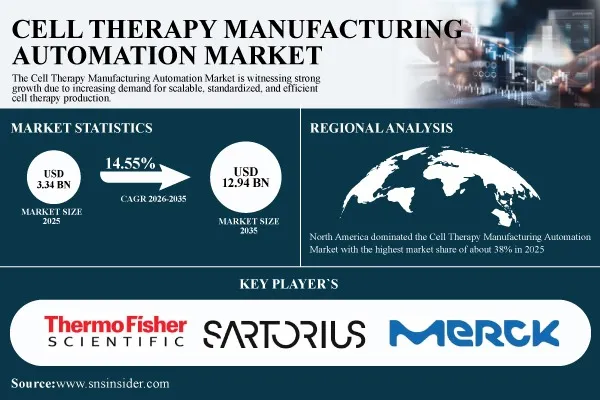
Austin, Texas, Sept. 15, 2026 (GLOBE NEWSWIRE) -- According to SNS Insider, The Cell Therapy Manufacturing Automation Market was valued at USD 3.34 Billion in 2025 and is expected to reach USD 12.94 Billion by 2035, growing at a CAGR of 14.55% from 2026 to 2035. Increased need for scalability, standardization, and efficiency in cell therapy manufacturing leads to growth because the intricacies involved in cell-based manufacturing require automation in various processes including cell manipulation, cell culture, medium handling, quality control, and filling. Automation can be used to reduce the need for human intervention, contamination, variability, and cost. It was noted by the FDA that the CBER had approved nearly 50 cell and gene therapies within the last decade.
Download the Cell Therapy Manufacturing Automation Market Sample Report: https://www.snsinsider.com/sample-request/10864
Cell Therapy Manufacturing Automation Market Key Highlights
- Market size, 2025: USD 3.34 Billion
- Market forecast, 2035: USD 12.94 Billion
- CAGR: 14.55% from 2026 to 2035
- Largest region: North America, approximately 38% share in 2025
- Fastest-growing region: Asia Pacific, approximately 16.28% CAGR
- Largest component: Hardware, approximately 48% share in 2025
- Fastest-growing component: Software, approximately 15.62% CAGR
- Largest process: Upstream Processing, approximately 26% share in 2025
- Fastest-growing process: Quality Control, approximately 16.23% CAGR
- Largest application: Clinical, approximately 43% share in 2025
- Fastest-growing application: Commercial, approximately 15.37% CAGR
- Largest cell type: T-Cells, approximately 43% share in 2025
- Fastest-growing cell type: Natural Killer (NK) Cells, approximately 16.32% CAGR
- Largest end user: Pharmaceutical & Biotechnology Companies, approximately 51% share in 2025
- Fastest-growing end user: Contract Manufacturing Organizations, approximately 16.60% CAGR
Market Relevance
Automation of manufacturing has become mandatory for scaling up cell therapies because traditional manufacturing has lots of manual operations such as cell harvesting, cell activation, cell proliferation, cell washing, cell formulation, and cell filling. Automation brings standardization and control into these processes, lowers chances of contamination, and results in quality products of growing CAR-T, stem cells, and natural killer cells therapies.
Cell Therapy Manufacturing Automation Market Overview
The market includes hardware and software solutions providing upstream processing and quality control for clinical and commercial cell therapy applications, which are used in the manufacturing of T-cell and natural killer cells for pharmaceutical and biotechnology companies as well as contract manufacturing organizations. Hardware represents the largest market segment due to the growing demand for automated bioreactors, cell processing devices, fillers, and material handling equipment. Meanwhile, software continues to grow significantly due to digital process control and manufacturing analytics capabilities.
Strategic Market Outlook
Growth opportunities exist in the quick commercialization of cell therapies, since advanced products beyond the clinical trial phase call for systems that can offer high throughput with quality control and low variation. The closed and automated systems offer protection against contamination and increase the safety of operators, and modular platform development facilitates the scaling up of production according to demand without the need to refit the entire plant, through more funds for cell therapy plants and manufacturing organization.
Capital costs and integration of the system remain the greatest challenges. Cell processing systems, bioreactor, robotics, monitoring tools, and software have high costs that might require the adaptation of the plant, and the integration of equipment from different suppliers within a single automation platform becomes another challenge. Biotechnology companies and early-phase developers that are still unsure about the volume of manufacturing cannot afford the cost, and the need for specialized operators has left some manufacturers on manual processes.
Cell Therapy Manufacturing Automation Market Regional Analysis
North America held the dominant share of 38% in 2025 due to the already existing infrastructure for manufacturing cell therapies, developed biotech and pharma industries, and the high demand for scalable manufacturing. In North America, the U.S. accounted for almost 91% of the revenue due to the availability of well-established cell therapy infrastructure and an extensive pipeline of therapies.
The U.S. Cell Therapy Manufacturing Automation Market was valued at USD 1.16 Billion in 2025 and is expected to reach USD 4.50 Billion by 2035, growing at a CAGR of 14.53% from 2026 to 2035.
The Europe Cell Therapy Manufacturing Automation Market was responsible for around 27% of the total share in the global market in 2025, worth USD 0.90 Billion, and anticipated to reach USD 3.34 Billion in 2035 at a CAGR of 14.00% during 2026 to 2035. The market growth is attributed to the increasing cell therapy research, rising number of clinical trials, and advancement in the drug manufacturing processes. Germany represented about 24.0% of European revenues in 2025, due to the growth in the pharmaceuticals manufacturing and biotechnology research.
The Asia Pacific region is anticipated to register the highest CAGR of around 16.28% during 2026 to 2035, due to the increase in cell therapy research, rising clinical trials, and biotechnology manufacturing in countries such as China, Japan, South Korea, and India. China accounted for about 42.0% of regional revenues in 2025 due to the support from the government and increase in pharmaceutical manufacturing.
Middle East & Africa: The UAE accounted for approximately 18.0% of regional revenue in 2025, facilitated by greater healthcare spending, biotechnology innovation, and government-led healthcare modernization.
Latin America: Brazil led regional revenue at approximately 35.0% in 2025, supported by growing biotechnology investment and expanding clinical study activity.
Buy the Cell Therapy Manufacturing Automation Market Report with Competitive Analysis and 2035 Forecast: https://www.snsinsider.com/checkout/10864
Cell Therapy Manufacturing Automation Market Segment Analysis
By Component: Hardware accounted for around 48% market share in 2025, driven by rising need for automated bioreactors, cell processing systems, and material handling equipment. Software is the fastest-growing component, at around 15.62% CAGR, driven by demand for digital process control, real-time monitoring, and manufacturing analytics.
By Process: Upstream Processing accounted for around 26% market share in 2025, driven by demands for controlled cell proliferation, culture, media handling, and process reproducibility. Quality Control is the fastest-growing process, at around 16.23% CAGR, driven by increasing regulation and the need for real-time quality monitoring during manufacturing.
By Application: Clinical applications accounted for around 43% market share in 2025, driven by growing cell therapy trial volumes requiring controlled manufacturing processes. Commercial is the fastest-growing application, at around 15.37% CAGR, driven by commercialization of approved therapies and the need for standardized, cost-effective scale-up.
By Cell Type: T-Cells accounted for around 43% market share in 2025, reflecting extensive development of CAR-T therapies requiring intricate proliferation, activation, modification, and harvest processes. Natural Killer (NK) Cells are the fastest-growing segment, at around 16.32% CAGR, driven by expanding research into NK cell-based immunotherapies and off-the-shelf treatment options.
By End User: Pharmaceutical & Biotechnology Companies accounted for around 51% market share in 2025, owing to heavy investment in cell therapy R&D, manufacturing, and commercialization. Contract Manufacturing Organizations are the fastest-growing segment, at around 16.60% CAGR, driven by increasing outsourcing of cell therapy development and manufacturing.
Cell Therapy Manufacturing Automation Market Key Trends
- Rising demand for cell therapies driving automation adoption to improve manufacturing scalability and consistency
- Increasing commercialization of CAR-T and other advanced cell therapies expanding demand for standardized workflows
- Growing need to reduce manual handling and contamination risks encouraging closed and automated processing systems
- Advancements in robotics, artificial intelligence, and process control improving manufacturing precision and reproducibility
- Increasing investment in cell therapy manufacturing facilities accelerating deployment of integrated production platforms
Major key players include
- Thermo Fisher Scientific Inc.
- Danaher Corporation (Cytiva)
- Sartorius AG
- Lonza Group AG
- Merck KGaA
- FUJIFILM Corporation
- Corning Incorporated
- Miltenyi Biotec
- Terumo Corporation
- Beckman Coulter Life Sciences
- WuXi AppTec Co., Ltd.
- Catalent, Inc.
- Cellares Corporation
- Resilience Corporation
- Minaris Regenerative Medicine
- Oxford Biomedica plc
- Ori Biotech Ltd.
- Repligen Corporation
- Fresenius Kabi AG
- Bio-Rad Laboratories, Inc.
Explore the Complete Cell Therapy Manufacturing Automation Market Report: https://www.snsinsider.com/reports/cell-therapy-manufacturing-automation-market-10864
CONTACT: About Us:
SNS Insider is one of the leading market research and consulting agencies that dominates the market research industry globally. Our company's aim is to give clients the knowledge they require in order to function in changing circumstances. In order to give you current, accurate market data, consumer insights, and opinions so that you can make decisions with confidence, we employ a variety of techniques, including surveys, video talks, and focus groups around the world.

Contact Us:
Rohan Jadhav - Principal Consultant
Phone: +1-315-961-9094 (US)
Email: info@snsinsider.com







Comments (0)
Login to join the conversation
Login / RegisterNo comments yet. Be the first to comment!