
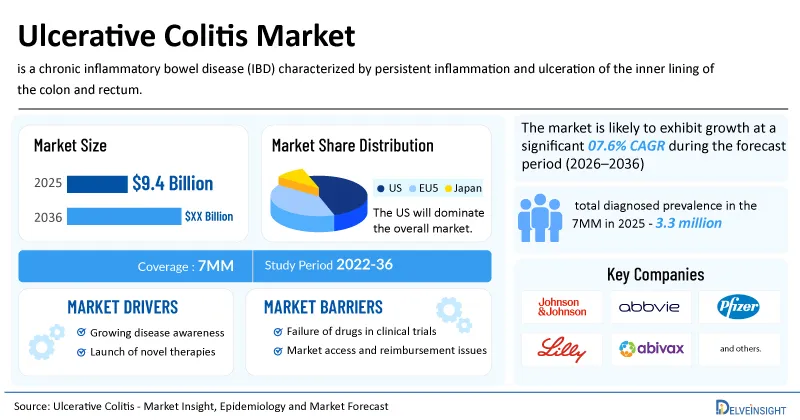
Emerging therapies for ulcerative colitis treatment, such as Obefazimod (Abivax), Tulisokibart (Merck), Olamkicept (Ferring Pharmaceuticals), Afimkibart (Roche), Icotrokinra (Johnson & Johnson/Protagonist Therapeutics), Duvakitug (Teva Pharmaceuticals/Sanofi), Zotemtegrast (Eli Lilly), Zasocitinib (Takeda), XmAb942 (Xencor), and others, reflect a growing ulcerative colitis market, advancing novel mechanisms to address unmet needs in moderate-to-severe disease.
New York, USA, Sept. 07, 2026 (GLOBE NEWSWIRE) -- Ulcerative Colitis Market Outlook: 5 Late-Stage Drug Candidates to Watch | DelveInsight
Emerging therapies for ulcerative colitis treatment, such as Obefazimod (Abivax), Tulisokibart (Merck), Olamkicept (Ferring Pharmaceuticals), Afimkibart (Roche), Icotrokinra (Johnson & Johnson/Protagonist Therapeutics), Duvakitug (Teva Pharmaceuticals/Sanofi), Zotemtegrast (Eli Lilly), Zasocitinib (Takeda), XmAb942 (Xencor), and others, reflect a growing ulcerative colitis market, advancing novel mechanisms to address unmet needs in moderate-to-severe disease.
Treatment selection generally depends on disease severity and includes conventional options such as aminosalicylates, corticosteroids, and immunomodulators, alongside biologics and oral targeted therapies. Despite the availability of multiple treatment options, many patients experience recurrent disease activity, treatment switching, or a gradual loss of response, resulting in a substantial long-term treatment burden and continued demand for effective therapies.
From a market standpoint, 5-aminosalicylic acid (5-ASA) therapies, including mesalamine, remain widely used in patients with mild-to-moderate ulcerative colitis and continue to serve as a key first-line treatment option. Corticosteroids play an important role in controlling acute disease flares, while immunomodulators such as azathioprine and 6-mercaptopurine have traditionally been used to support long-term disease management.
Discover what is the best medicine for ulcerative colitis @ https://www.delveinsight.com/report-store/ulcerative-colitis-uc-market
However, concerns surrounding long-term corticosteroid use and the safety limitations of conventional immunosuppressive therapies have contributed to an increasing preference for advanced treatment options. The treatment landscape has undergone considerable transformation with the expanding use of biologics, particularly anti-TNF therapies such as Infliximab (REMICADE), Adalimumab (HUMIRA), and Golimumab (SIMPONI), which remain established options for patients with moderate-to-severe disease.
At the same time, the introduction of biosimilars, including Infliximab-dyyb (INFLECTRA), Infliximab-abda (RENFLEXIS), and Infliximab-axxq (AVSOLA), has intensified competition within the biologics market while helping improve patient access through potentially lower treatment costs. Beyond the anti-TNF class, newer biologic therapies, including Vedolizumab (ENTYVIO), Ustekinumab (STELARA), Mirikizumab (OMVOH), Guselkumab (TREMFYA), and Risankizumab (SKYRIZI), are further reshaping the ulcerative colitis treatment paradigm through targeted mechanisms of action and differentiated clinical benefits.
Oral advanced therapies such as Tofacitinib (XELJANZ), Ozanimod (ZEPOSIA), Upadacitinib (RINVOQ), and Etrasimod (VELSIPITY) are also gaining increasing attention, supported by the convenience of oral administration and favorable clinical outcomes. Meanwhile, a growing pipeline of emerging therapies, including obefazimod from Abivax, tulisokibart from Merck, and Duvakitug from Teva Pharmaceuticals/Sanofi, Afimkibart from Roche, and Icotrokinra from Johnson & Johnson and Protagonist Therapeutics, highlights continued innovation in the ulcerative colitis space.
These investigational candidates are exploring novel mechanisms and may help address persistent unmet needs, particularly among patients with moderate-to-severe or treatment-refractory disease. Overall, the ulcerative colitis market is increasingly moving toward targeted biologics, oral advanced therapies, and more personalized treatment approaches. While biosimilar competition is expected to continue exerting pricing pressure on established biologic classes, future market expansion will likely be supported by therapies offering greater treatment durability, improved safety and tolerability, convenient administration, and enhanced efficacy for patients who do not respond adequately to existing treatments.
Reflecting continued therapeutic innovation and a substantial unmet medical need, DelveInsight estimates that the ulcerative colitis market across the seven major markets, comprising the United States, EU4 (Germany, France, Italy, and Spain), the United Kingdom, and Japan, was valued at approximately USD 9.4 billion in 2025. The market is projected to expand at a CAGR of 7.6% during the forecast period through 2036, driven by the development of novel targeted therapies, advances in biologic and small-molecule treatments, increasing investment in ulcerative colitis research, rising disease prevalence, and growing efforts to address treatment-resistant and moderate-to-severe disease.
Aparna Thakur, project manager of forecasting at DelveInsight, said that the market uptake is expected to increasingly shift toward newer IL-23 inhibitors and oral targeted therapies, while older conventional therapies and anti-TNFs continue to retain substantial use due to affordability and established treatment experience.
Below, we highlight 5 promising emerging late-stage therapies poised to reshape the future of the ulcerative colitis market.
Abivax’s ABX464 (Obefazimod)
miR-124 enhancer
Abivax’s ABX464, also known as obefazimod, is an oral, first-in-class small-molecule therapy designed to selectively increase miR-124 expression in immune cells. The molecule has demonstrated a favorable safety profile and significant anti-inflammatory effects across preclinical studies and Phase IIa and IIb induction trials in ulcerative colitis. Its differentiated mechanism of action is based on substantially enhancing the production of miR-124, a distinctive RNA splicing product with anti-inflammatory properties. Clinical studies have further highlighted its potential to induce remission and promote healing of inflammatory lesions in patients with ulcerative colitis.
At ECCO 2026, Phase III findings for obefazimod in ulcerative colitis demonstrated rapid and early improvements in patient-reported symptoms, while its safety profile remained comparable to placebo. Topline results from the pivotal Phase III maintenance study were anticipated in late Q2 2026.
In July 2025, Abivax reported positive Phase III results from the two ABTECT 8-week induction studies evaluating obefazimod, its first-in-class oral miR-124 enhancer, in patients with moderately to severely active ulcerative colitis. Treatment with obefazimod 50 mg once daily produced a pooled placebo-adjusted clinical remission rate of 16.4% at Week 8, including rates of 19.3% in ABTECT-1 and 13.4% in ABTECT-2.
Merck’s Tulisokibart
Tumor necrosis factor (TNF)-like ligand 1A inhibitor
Merck’s Tulisokibart is an investigational humanized monoclonal antibody targeting tumor necrosis factor (TNF)-like ligand 1A (TL1A). The asset became part of the portfolio through the acquisition of Prometheus Biosciences and has advanced to Phase III development for ulcerative colitis. Earlier Phase II data from the NCT04996797 study demonstrated that tulisokibart was more effective than placebo in inducing clinical remission among patients with moderately to severely active ulcerative colitis.
In June 2026, Merck reported positive topline results from the Phase 3 ATLAS-UC induction-only study (Study 2) evaluating tulisokibart (MK-7240) in patients with moderately to severely active ulcerative colitis (UC). The trial met its primary endpoint, demonstrating clinical remission at week 12 based on the Modified Mayo Score (MMS), and also achieved key secondary endpoints. The safety profile remained consistent with previously reported Phase 2 findings, with no new safety concerns identified.
Learn more about what is the latest treatment for ulcerative colitis @ Ulcerative Colitis Treatment
Roche’s Afimkibart
TLA1
Roche’s afimkibart is a monoclonal antibody targeting TL1A, a cytokine involved in inflammation through the TH1 and TH17 pathways, giving the therapy potential across multiple immune-mediated diseases. Roche acquired the anti-TL1A antibody, which can be administered either intravenously or subcutaneously, through its $7.1 billion acquisition of Telavant in October 2023. In the Phase IIb TUSCANY-2 trial, 35% of patients with ulcerative colitis receiving 15 mg of afimkibart achieved clinical remission at Week 14, compared with 12% of those receiving placebo, establishing a benchmark for Merck’s tulisokibart. Afimkibart is currently being evaluated in Phase III trials for ulcerative colitis, with regulatory filing anticipated in 2027, while development in Crohn’s disease is expected to lead to a regulatory submission after 2028.
Johnson & Johnson and Protagonist Therapeutics’ Icotrokinra
Interleukin-23 receptor antagonists
Icotrokinra is a first-in-class, once-daily oral peptide developed jointly by Protagonist Therapeutics and Johnson & Johnson that works by selectively blocking the interleukin-23 (IL-23) receptor with picomolar affinity, offering a targeted mechanism previously available only via injectable biologics. In ulcerative colitis specifically, it is being evaluated in the Phase 2b ANTHEM-UC trial (n=252), which enrolled adults with moderately to severely active UC who had an inadequate response or intolerance to conventional therapy, biologics, or JAK inhibitors, testing three once-daily oral doses against placebo. At Week 12, icotrokinra met its primary endpoint of clinical response at all three doses, with 36.5% of patients on the highest dose achieving endoscopic improvement, and Week 28 data (presented at ACG 2025) showed sustained, clinically meaningful clinical response, remission, endoscopic improvement, and histologic-endoscopic mucosal improvement across all doses versus placebo. Subgroup data reported in mid-2026 further highlighted benefit even in patients who had previously failed advanced therapies. Based on these results, J&J has advanced the drug into the Phase 3 ICONIC-UC program in adults and adolescents, alongside a related Phase 2b/3 program (ICONIC-CD) in Crohn's disease, with a new UC/Crohn's protocol trial (NCT07196748) started in October 2025 and running through 2028–2032.
To know more about the list of medications for ulcerative colitis, visit @ Ulcerative Colitis Medications
Teva Pharmaceuticals/Sanofi’s Duvakitug
Tumour necrosis factor ligand superfamily member 15 inhibitors
Duvakitug is a fully human monoclonal antibody directed against TL1A and is currently being evaluated in Phase III clinical trials for ulcerative colitis (UC) and Crohn’s disease (CD). TL1A is thought to contribute to the inflammatory and fibrotic processes associated with inflammatory bowel disease (IBD) through interaction with its receptor, DR3. Duvakitug selectively inhibits TL1A-DR3 signaling while preferentially avoiding binding to the decoy receptor DcR3, potentially addressing both inflammation and fibrosis. The safety and efficacy of duvakitug have not yet been evaluated by any regulatory authority.
Under a separate agreement announced in 2023, Teva is jointly developing duvakitug with Sanofi and, subject to regulatory approval, will co-commercialize the therapy. In March 2026, Teva Pharmaceuticals, the U.S. affiliate of Teva Pharmaceutical Industries Ltd., and funds managed by Blackstone Life Sciences entered into a $400 million strategic funding agreement, to be provided over four years, to support the continued clinical development of duvakitug. Under the agreement, BXLS is also eligible to receive regulatory and commercial milestone payments, along with royalties based on worldwide sales of duvakitug.
Discover more about anti inflammatory drugs for ulcerative colitis @ Ulcerative Colitis Clinical Trials
Source: Ulcerative Colitis Market Report
Ulcerative Colitis Market Insights, Epidemiology, and Market Forecast – 2036 report delivers an in-depth understanding of the disease, historical and forecasted epidemiology, as well as the market trends, market drivers, market barriers, and key ulcerative colitis companies, including Arena Pharmaceuticals, Roche, Pfizer, Abivax, Reistone Biopharma, InDex Pharmaceuticals, AbbVie, Boehringer Ingelheim, Janssen Pharmaceuticals, NImmune, Merck, Mesoblast, and others.
Related Reports
Ulcerative Colitis Pipeline Insight – 2026 report provides comprehensive insights about the pipeline landscape, pipeline drug profiles, including clinical and non-clinical stage products, and the key ulcerative colitis companies, including Oppilan Pharma, Genentech, Teva Branded Pharmaceutical, Boehringer Ingelheim, Sorriso Pharmaceuticals, Reistone Biopharma, Celgene, AnaptysBio, Rise Therapeutics, Merck, AltruBio, AbbVie, Immunic AG, Kissei Pharmaceutical Co, Lmito Therapeutics, Morphic Therapeutic, Oncostellae, Palatin Technologies, and others.
Crohn's Disease Market Insights, Epidemiology, and Market Forecast – 2036 report deliver an in-depth understanding of the disease, historical and forecasted epidemiology, as well as the market trends, market drivers, market barriers, and key Crohn's disease companies including RedHill Biopharma, Merck, Teva Pharmaceutical, Pfizer, Agomab Therapeutics, Sanofi, Medibiofarma, Eli Lilly, NImmune, Avobis Bio, Abivax, Roche, Telavant, Mesoblast, Takeda, AstraZeneca, and others.
Crohn's Disease Pipeline Insight – 2026 report provides comprehensive insights about the pipeline landscape, pipeline drug profiles, including clinical and non-clinical stage products, and the key Crohn's disease companies, including TiumBio Co., Jiangsu Gensciences Inc., Pfizer, Novo Nordisk, Genzyme, AbbVie, Bayer, Spark Therapeutics, G & P Bioscience, Gritgen Therapeutics, Biocad, Belief Biomed, Chugai Pharmaceutical, Staidson Beijing BioPharmaceuticals, Jiangsu Gensciences, Poseida Therapeutics, Chia Tai Tianqing Pharmaceutical Group, Takeda, and others.
Inflammatory Bowel Disease Market Insights, Epidemiology, and Market Forecast – 2036 report delivers an in-depth understanding of the disease, historical and forecasted epidemiology, as well as the market trends, market drivers, market barriers, and key IBD companies, including Abivax, Merck, RedHill Biopharma, Teva Pharmaceuticals, Sanofi, Agomab, Ferring Pharmaceuticals, Johnson & Johnson, Eli Lilly, Athos Therapeutics, Spyre Therapeutics, Inc., Direct Biologics, LLC, Takeda, AbbVie, Tr1X, Inc., Xencor, Inc., Pfizer, Celltrion, and others.
Inflammatory Bowel Disease Diagnostics Market Insights, Competitive Landscape, and Market Forecast – 2034 report delivers an in-depth understanding of the market trends, market drivers, market barriers, and key IBD diagnostics companies, including AMedtronic, GE Healthcare, Canon Medical Systems Corporation, FUJIFILM Holdings Corporation, Hologic Inc., SternMed GmbH, Koninklijke Philips N.V., Seimens Healthineers, Shenzhen Mindray Bio-Medical Electronics Co., Ltd., Samsung Medison (Samsung Electronics Co., Ltd.), Thermofisher Scientific Inc., AbbVie Inc., TECHLAB, Inc., Svar Life Science, and others.
About DelveInsight
DelveInsight is a leading Business Consultant and Market Research firm focused exclusively on life sciences. It supports pharma companies by providing comprehensive end-to-end solutions to improve their performance. Get hassle-free access to all the healthcare and pharma market research reports through our subscription-based platform PharmDelve.
CONTACT: Contact Us

Shruti Thakur

info@delveinsight.com

+14699457679





Comments (0)
Login to join the conversation
Login / RegisterNo comments yet. Be the first to comment!