
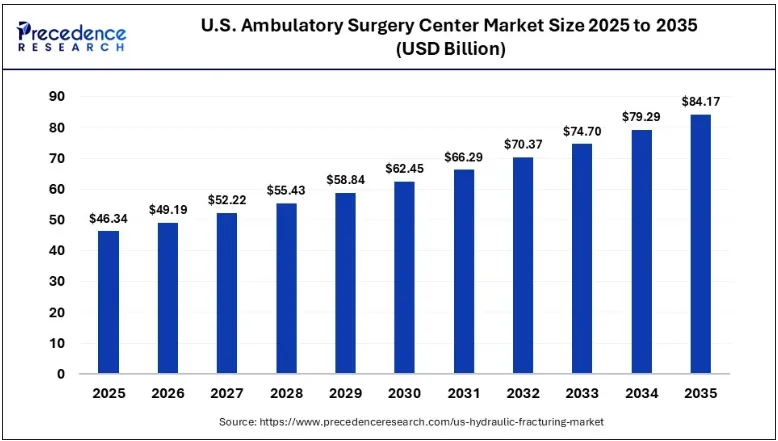
The U.S. ambulatory surgery center (ASC) market is entering a significant phase of expansion as healthcare providers, physicians, payers and investors accelerate the migration of appropriate procedures toward lower-cost outpatient settings. According to Precedence Research, the market was valued at USD 49.19 billion in 2026 and is projected to reach USD 84.17 billion by 2035, expanding at a 6.15% CAGR from 2026 to 2035.
Ottawa, Oct. 08, 2026 (GLOBE NEWSWIRE) -- October 8, 2026
The U.S. ambulatory surgery center (ASC) market is gaining momentum as healthcare systems, physicians, payers, and investors increasingly shift eligible surgical procedures from hospital settings to cost-efficient outpatient facilities. According to Precedence Research, the U.S. ASC market is valued at USD 49.19 billion in 2026 and is expected to reach USD 84.17 billion by 2035, registering a 6.15% CAGR between 2026 and 2035.
The opportunity extends beyond overall revenue growth. The U.S. has approximately 6,000-6,600 Medicare-certified ASCs, while only about one-third of freestanding centers are affiliated with larger multi-site operators. The resulting fragmentation creates substantial opportunities for acquisitions, joint ventures, de novo development, physician partnerships, technology deployment and market expansion.
Fill out the form for samples, case studies, and examples: https://www.precedenceresearch.com/sample/8764
Market Data Snapshot
| Metric | 2026 Data / Outlook | Business Implication | |
| U.S. ASC market size | USD 49.19 billion | Large addressable market for operators, suppliers, technology providers and investors | |
| Forecast market size | USD 84.17 billion by 2035 | Indicates substantial long-term expansion opportunity | |
| CAGR, 2026-2035 | 6.15% | Supports continued capacity, technology and geographic investment | |
| Medicare-certified ASCs | 6,000-6,600 | Highly fragmented facility base creates consolidation opportunities | |
| Five largest multi-site operators | 22% of centers | Significant market remains outside large national platforms | |
| Largest operator share | 8% of centers | No single operator dominates the facility landscape | |
| Market growth scenarios | 3.5%-7% | Procedure migration, utilization and capacity determine upside | |
| Major specialty pools | 12 categories | Multiple pathways for specialty-focused expansion | |
The underlying growth equation is increasingly influenced by procedure migration, case acuity, utilization, reimbursement, facility capacity and revenue per case, rather than center count alone. Precedence Research identifies orthopedics, ophthalmology, gastroenterology, pain management, ENT, urology and other procedural specialties as important components of the addressable ASC opportunity.
What the Latest Data Shows
The ASC market is evolving from a predominantly low-acuity outpatient model toward a broader platform capable of handling increasingly complex procedures. Advances in minimally invasive techniques, anesthesia, perioperative protocols, imaging and recovery management are expanding the range of procedures that can be performed without an overnight hospital stay.
Three structural forces are particularly important:
- Site-of-care migration: More clinically appropriate procedures are moving from hospitals and hospital outpatient departments into ASCs.
- Payer economics: Lower-cost outpatient settings create incentives to direct suitable procedures away from higher-cost hospital environments.
- Physician alignment: Physician ownership, partnerships and joint ventures can influence case volume, facility utilization and investment decisions.
The economics are also becoming more dependent on higher-value procedures. Precedence Research notes that a leading national ASC operator recorded 3.5% same-facility case growth and 1.5% revenue-per-case growth in 2025, illustrating how procedure volume and case value can jointly influence revenue expansion.
Key Market Trends and Developments
Higher-Acuity Procedures Are Expanding the Addressable Market
Orthopedics is becoming particularly important as procedures historically concentrated in hospital settings increasingly become suitable for outpatient environments. Cardiovascular and spine procedures also represent areas where technology, patient selection and clinical protocols can expand ASC eligibility.
The market's specialty mix includes:
- Orthopedics
- Ophthalmology
- Gastroenterology
- Pain management
- ENT
- General surgery
- Urology
- Gynecology
- Cardiovascular procedures
- Spine
- Podiatry
- Other specialties
For ASC operators, the strategic question is therefore shifting from “How many centers can we operate?” to “Which procedures, physicians and markets generate the strongest facility economics?”
Consolidation Is Accelerating
The fragmented market structure provides a significant pipeline for acquisitions, affiliations and joint ventures. Large operators are combining national scale with physician relationships and specialty expertise, while independent centers remain important targets for strategic expansion.
A major 2026 transaction illustrates the scale of consolidation: Ascension completed its acquisition of AMSURG, bringing more than 250 ambulatory surgery centers across 34 states into its national network.
The transaction also demonstrates why facility-level intelligence matters. The competitive value of an ASC depends on its location, specialty mix, physician relationships, procedure volumes, payer exposure and local competitive density—not simply the number of facilities acquired.
Capacity and Physician Recruitment Are Strategic Variables
Surgery Partners reported 157 ASCs and 19 surgical hospitals across 30 states at the end of 2025. Its 2025 revenue increased 6.2% to $3.31 billion, while same-facility revenue increased 4.9%, same-facility cases increased 3.4%, and revenue per case increased 1.4%. The company also recruited nearly 700 physicians and invested more than $180 million in acquisitions, robotic technology and de novo development.
These figures highlight a broader market trend: facility expansion, physician recruitment, technology investment and higher-acuity procedure growth are increasingly interconnected.
Regulatory and Reimbursement Intelligence Is Becoming More Important
For calendar year 2026, the ASC payment-rate update was finalized at 2.6% for ASCs meeting applicable quality-reporting requirements. The 2026 payment framework also includes changes involving ASC quality reporting and other outpatient payment policies.
For operators and investors, reimbursement intelligence needs to be evaluated alongside procedure migration, payer mix, local contracting, utilization and facility-level economics.
Buy the Report: https://www.precedenceresearch.com/checkout/8764
Segment and Regional Intelligence
| Segment | Current Position | Growth Signal | Business Opportunity |
| Orthopedics | Major high-value procedure pool | Higher-acuity procedures expanding | Joint replacement, spine, musculoskeletal services and specialized facilities |
| Ophthalmology | Established ASC specialty | High procedure volume | Specialty centers, equipment and technology |
| Gastroenterology | Large established outpatient pool | Continued specialty-network expansion | GI-focused centers, equipment and physician partnerships |
| Pain Management | Established outpatient specialty | Continued demand | Specialty facilities and physician alignment |
| Cardiovascular | Emerging higher-acuity opportunity | Procedure eligibility expanding | Advanced technology, facility development and clinical capabilities |
| ENT | Established ASC specialty | Continued outpatient suitability | Specialty expansion and network development |
| Region | Market Consideration | Opportunity |
| South | Large healthcare footprint and substantial ASC activity | Network expansion, acquisitions and physician partnerships |
| West | Population growth and metropolitan demand | De novo centers and specialty expansion |
| Midwest | Diverse regional markets | Independent-center acquisition and affiliation |
| Northeast | Dense healthcare infrastructure | Specialty and hospital-to-ASC migration opportunities |
Precedence Research identifies state and metropolitan-level analysis as particularly important because ASC economics vary substantially according to population growth, procedure demand, reimbursement, ASC penetration, hospital competition and migration potential.
Company and Competitive Intelligence
The competitive landscape includes national operators, hospital systems, physician-led platforms, specialty networks and regional ASC groups.
| Company / Platform | Recent Development or Position | Strategic Significance |
| United Surgical Partners International | National-scale ASC platform | Scale, joint ventures and multispecialty expansion |
| SCA Health | National physician-partnership model | Physician alignment and network development |
| AMSURG | Expanded through major network combination and additional center acquisitions | Specialty scale and consolidation |
| HCA Healthcare | Operated 121 freestanding ASCs at year-end 2025 | Integrated hospital-to-outpatient network |
| Surgery Partners | 157 ASCs across 30 states at year-end 2025 | Physician partnerships, acquisitions and higher-acuity growth |
| Regional physician-owned ASCs | Large fragmented market | Acquisition, affiliation and partnership pipeline |
HCA Healthcare reported 121 freestanding ASCs and 31 freestanding endoscopy centers at December 31, 2025, reinforcing the importance of integrated outpatient networks within large healthcare systems.
AMSURG also expanded its portfolio in July 2026 through the acquisition of five North Carolina centers, demonstrating continued activity at the regional level alongside larger national consolidation.
Where the Market Opportunity Is Emerging
The data points toward several high-value opportunity areas:
1. Independent ASC consolidation
With only about one-third of freestanding ASCs connected to large multi-site operators, thousands of centers remain potential targets for acquisition, affiliation or joint-venture strategies.
2. Hospital-to-ASC migration
Procedures becoming clinically and economically suitable for outpatient treatment can create new demand for ASC capacity, equipment, staffing and technology.
3. Higher-acuity outpatient care
Orthopedic, cardiovascular and spine procedures can expand the revenue pool where clinical capability, reimbursement and infrastructure support migration.
4. Physician partnership models
Recruitment and alignment remain critical because physician relationships directly influence procedure volume and facility utilization.
5. Technology investment
Robotic surgery, advanced imaging, digital scheduling, patient-management platforms, monitoring technologies and advanced anesthesia systems are becoming increasingly relevant to ASC competitiveness.
How Precedence Research Helps Companies in the U.S. ASC Market
Precedence Research converts market developments into structured intelligence that can support expansion, competitive strategy, investment, sourcing, sales and business development decisions.
| Precedence Research Solution | What the Client Gets | How It Helps in the U.S. ASC Market |
| Master Dataset | Companies, ASC facilities, specialties, procedures, ownership, locations, physicians, technologies, investments and expansion activity | Identify acquisition targets, white-space markets, prospects, partners and expansion opportunities |
| Precedence Quadrant | Competitive benchmarking across scale, capabilities, positioning, specialty exposure and strategic strength | Compare ASC operators, identify competitive gaps and assess positioning |
| Interactive Dashboard | Dynamic monitoring of companies, segments, regions, competitors, investments and market indicators | Track market changes without relying exclusively on static reports |
| Quality & Manufacturing Intelligence | Facility, capacity, technology, supplier, operational and development intelligence where applicable | Support equipment suppliers, technology companies, procurement and operational planning |
| Customized Research | Market-entry studies, customer intelligence, competitor research, opportunity mapping, pricing, demand and investment analysis | Answer specific expansion, GTM, M&A, investment and strategic questions |
Master Dataset
For the ASC market, a market-specific dataset can map ASC operators, individual facilities, specialties, procedure exposure, ownership models, geographic presence, physician relationships, technology adoption, investments, acquisitions, partnerships and expansion plans.
Healthcare companies and suppliers can use this intelligence to identify target facilities, prioritize accounts, map competitive presence, identify underserved markets and build territory-level sales strategies.
Precedence Quadrant
Competitive benchmarking can evaluate operators according to facility scale, geographic footprint, specialty exposure, physician relationships, procedure capabilities, technology adoption, expansion activity and strategic positioning.
This enables decision-makers to distinguish between companies with large networks and companies generating strong facility-level or specialty-specific advantages.
Interactive Dashboard
Decision-makers can monitor changes across:
- ASC operators and facility networks
- Specialty and procedure trends
- State and metropolitan markets
- Competitor expansion
- Acquisitions and joint ventures
- Technology deployment
- Physician partnerships
- Investment activity
- Market and demand indicators
This creates an ongoing intelligence layer for strategy, sales, business development and executive decision-making.
Quality & Manufacturing Intelligence
For ASC equipment, medical-device and healthcare-technology companies, intelligence can be structured around facility locations, installed capabilities, procedure requirements, technology adoption, capacity expansion, procurement signals, suppliers and operational developments.
This can help manufacturers identify where new ASC capacity is being developed, determine which facilities are potential customers, prioritize high-growth specialties and align product portfolios with evolving procedural requirements.
Customized Research
Precedence Research can develop market-specific studies covering:
- ASC market-entry strategy
- State and metropolitan opportunity assessment
- Customer and buyer intelligence
- Competitive intelligence
- ASC company profiling
- Facility-level opportunity mapping
- Procedure and specialty intelligence
- Technology adoption assessment
- Demand analysis
- Pricing and reimbursement analysis
- Supplier intelligence
- M&A target identification
- Strategic benchmarking
- Investment opportunity assessment
- GTM strategy
Continuously Updated Market Intelligence
ASC market intelligence can be maintained according to the client's operating requirements through monthly, quarterly, six-monthly or annual updates.
Monthly updates can support companies tracking acquisitions, facility openings, partnerships, product launches, major investments and competitor activity.
Quarterly intelligence can support commercial and strategy teams monitoring procedure trends, network expansion, physician recruitment, technology adoption and competitive positioning.
Six-monthly updates can provide a broader review of market structure, regional opportunity, capacity development and strategic shifts.
Annual updates can refresh market forecasts, competitive landscapes, segment opportunities, reimbursement developments and long-term investment priorities.
The objective is to ensure that companies are not making strategic decisions using outdated facility, competitor, technology or market information.
Conclusion
The U.S. ASC market is moving into a period where scale, procedure migration, physician alignment, facility productivity, technology adoption and local-market economics will increasingly determine competitive success. With a USD 49.19 billion market in 2026, a projected 6.15% CAGR, approximately 6,000-6,600 Medicare-certified ASCs, and a highly fragmented ownership structure, the market offers opportunities across operations, healthcare delivery, medical technology, investment, acquisitions and business development.
For companies competing in or supplying the ASC ecosystem, the key requirement is increasingly granular intelligence: which facilities are expanding, which procedures are migrating, which operators are acquiring, where capacity is being added, which technologies are being adopted, and which markets offer the strongest commercial potential.
Precedence Research provides the market data, competitive intelligence, facility-level analysis and customized research required to turn these developments into actionable business decisions.
Related Reports
- Image Guided Surgery Devices Market -: https://www.precedenceresearch.com/image-guided-surgery-devices-market
- Endoscopic Spinal Surgery Equipment Market: https://www.precedenceresearch.com/endoscopic-spinal-surgery-equipment-market
- Dental Microsurgery Marke: https://www.precedenceresearch.com/dental-microsurgery-market
- Emergency General Surgery Services Market: https://www.precedenceresearch.com/emergency-general-surgery-services-market
- Spine Surgery Robots Market: https://www.precedenceresearch.com/spine-surgery-robots-market
- Cosmetic Surgery and Procedures Marke: https://www.precedenceresearch.com/cosmetic-surgery-and-procedure-market
- Thoracic Surgery Devices Market: https://www.precedenceresearch.com/thoracic-surgery-devices-market
- Ambulatory Cardiac Monitoring Devices Market: https://www.precedenceresearch.com/ambulatory-cardiac-monitoring-devices-market
- Cosmetic Surgery Market: https://www.precedenceresearch.com/cosmetic-surgery-market
- Stereotactic Surgery Devices Market: https://www.precedenceresearch.com/stereotactic-surgery-devices-market
Connect With Us
- USA : +1 804 441 9344
- APAC : +61 485 981 310 or +91 87933 22019 | +6531051271
- Europe : +44 7383 092 044
- Email : sales@precedenceresearch.com
Stay Connected with Precedence Research:
- Find us on Social Platforms: Linkedin | Facebook | X | Medium
- Our Trusted Data Partners: Towards Healthcare | Towards Packaging | Towards Chemical and Materials






Comments (0)
Login to join the conversation
Login / RegisterNo comments yet. Be the first to comment!