
U.S. AI in Construction Market to Reach USD 11.77 Billion by 2035 as North America Leads and Asia Pacific Emerges as the Fastest-Growing Region on Robotics and Safety Monitoring Adoption.
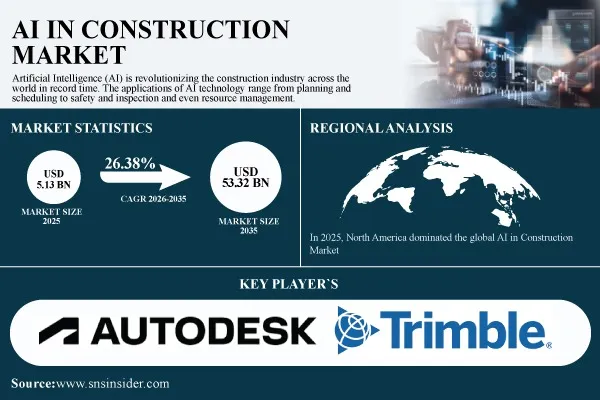
Austin, Sept. 07, 2026 (GLOBE NEWSWIRE) -- According to SNS Insider, The AI in Construction Market was valued at USD 5.13 Billion in 2025 and is expected to reach USD 53.32 Billion by 2035, growing at a CAGR of 26.38% from 2026 to 2035. Growth is the structural labor shortage faced by over 40 million construction workers globally, along with the problem of project cost overruns, which AI-powered planning, scheduling, and safety measures are successfully tackling. Early adopters have seen productivity increases in the range of 15-25%, while industry analysts view AI as one of the critical construction technologies until 2035.
Scheduling and cost estimation based on machine learning, computer vision safety monitoring, and autonomous robots for earth moving and bricklaying are coming together with Building Information Modeling software for integrated AI-powered construction management solutions globally.
Download the AI in Construction Market Sample Report: https://www.snsinsider.com/sample-request/8901
AI in Construction Market Key Highlights
- Market size, 2025: USD 5.13 Billion
- Market forecast, 2035: USD 53.32 Billion
- CAGR: 26.38% from 2026 to 2035
- Largest region: North America, with the United States generating approximately 83.7% of the region's revenue in 2025
- Fastest-growing region: Asia Pacific, led by China at approximately 48.3% of regional revenue, on smart city programs and Belt and Road infrastructure deployment
- Largest offering type: Software, approximately 57.42% share in 2025
- Fastest-growing offering type: Services, approximately 32.84% CAGR
- Largest technology: Machine Learning, approximately 45.18% share in 2025
- Fastest-growing technology: Robotics, approximately 35.67% CAGR
- Largest application: Project Planning & Design, approximately 38.72% share in 2025
- Fastest-growing application: Safety & Risk Management, approximately 36.21% CAGR
Market Relevance
Construction is still considered one of the least digitalized industries prone to accidents. Large-scale projects are over-budgeted on average by 80%, and there are labor shortages in over 40 million positions worldwide. The use of AI in planning, scheduling, and safety monitoring of construction sites addresses these very inefficiencies, providing real tangible benefits in decreased rework and incident rates.
AI in Construction Market Overview
Market coverage includes AI-integrated software solutions as well as implementation services across project planning and design, safety and risk management, and resource management areas, driven by machine learning, computer vision, and robotics. Project management software powered by machine learning is employed by major global contractors in cost estimation and scheduling, whereas robotics solutions offered by companies such as Construction Robotics, FBR, and Built Robotics automate bricklaying, earthwork, and inspections at a speed that surpasses even the overall category of technology.
Strategic Market Outlook
Combining AI with Building Information Modeling, automated drone inspections that reduce costs of site surveys by 60 to 80% as compared to conventional surveys, and smart infrastructure projects supported by governments in Asia, Middle East, and North America have opened up significant avenues for growth in the market. Reduction in premiums offered by insurance and bonding firms in return for adopting AI safety solutions and the need for AI risk monitoring by lenders as part of loan covenant conditions are driving adoption.
Expensive implementation costs have been impeding the process of adoption by smaller players. Lack of consistent quality of data in project management software, conservatism of industry personnel, cybersecurity risks on networked construction sites, and lack of competent AI implementation professionals are hampering wider adoption of the technology.
AI in Construction Market Regional Analysis
The North American continent led the global market share in 2025 with around 83.7% revenue share of the region held by the United States due to high investments in government infrastructures, robust construction technology startups in the region, and continuous flow of venture capital funding. The shortage of labor will force the Tier-1 contractors to use AI-based solutions for all their projects.
The U.S, AI in Construction Market size was around USD 1.43 Billion in 2025 and is expected to reach approximately USD 11.77 Billion by 2035, growing at a CAGR of 23.47% due to the passage of the Infrastructure Investment and Jobs Act, more than 500,000 open construction job opportunities as of 2025, and fast adoption by some leading construction companies like Turner Construction Company, Bechtel, and others.
The European region is a technologically mature and advanced market with Germany contributing approximately 25.4% to the regional revenue because of its culture of industrial automation supported by BIM mandate and need for AI-based building energy optimization software in countries, such as the U.K., France, and the Netherlands due to Green Deal initiative.
The fastest growing region is Asia Pacific, where China contributes to nearly 48.3% of the regional revenue due to its Belt and Road infrastructure project and smart cities program. Smart cities programs of India, robotics of Japan and South Korea to tackle their labor shortages, mining and infrastructure of Australia are some other factors contributing to the growth of this region.
Buy the AI in Construction Market Report with Competitive Analysis and 2035 Forecast: https://www.snsinsider.com/checkout/8901
AI in Construction Market Segment Analysis
By Type of Offering: Software had the highest market share of about 57.42%, used in planning, safety management, and prediction. The segment with the fastest growth is that of services, growing at an average annual growth rate of about 32.84%, given the need for integration and implementation of AI technology into contractors’ companies.
By Technology: In terms of market share Machine Learning emerged as the leader with about 45.18% in 2025, enabling automated decision-making and cost and resource forecasting within project management applications employed by large-scale construction companies worldwide. Robotic technologies became the highest-growing segment with the CAGR of about 35.67%, including bricklaying robots, self-driving cars, and drones from companies such as Construction Robotics and FBR that build bricks three times quicker than people.
By Application: Project planning & Design had the highest market share of about 38.72%, powered by the use of artificial intelligence-based BIM collaboration and generative design tools, which offer viable design solutions within hours. The application witnessing the fastest growth in terms of CAGR of about 36.21% is the Safety & Risk Management, due to computer vision and biometrics-based fatigue monitoring.
By End-Use: Infrastructure held the largest share in 2025, underpinned by government investment in roads, bridges, and energy projects. Commercial construction is the fastest-growing end-use segment, driven by smart building adoption and mounting cost-efficiency pressure on developers.
AI in Construction Market Key Trends
- Predictive analytics combined with IoT sensor data is helping proactively manage project budgets and schedules, mitigating the risk of cost overruns
- Computer vision-based site safety monitoring is being increasingly adopted to detect PPE violations and risky worker behavior in real time
- Generative AI is accelerating building design, enabling architects to produce viable models in hours rather than days or weeks
- Autonomous machines are increasingly performing site preparation, trenching, pipe-laying, and concrete pouring tasks
- Digital twin adoption is expanding across mega-projects, allowing construction teams to simulate build processes digitally before execution
Competitive Landscape
The AI in Construction Market includes established construction technology, BIM, and industrial automation leaders alongside a fast-growing set of specialized AI and robotics vendors.
In 2025, Autodesk extended its Construction IQ platform to deliver prediction-based safety and scheduling risk analytics to construction projects. In 2025, Trimble introduced AI-enabled versions of its SketchUp and Tekla BIM platforms with generative design tools that let engineers generate hundreds of viable design iterations simultaneously. Also in 2025, Hilti Group implemented an AI-based tool tracking and predictive maintenance system across its fleet management operations, cutting downtime by 30% and automating documentation for contractors, while Built Robotics expanded its autonomous excavation systems past 500,000 cumulative autonomous earthwork hours at commercial sites, and Komatsu, in July 2025, launched a next-generation SmartConstruction platform combining drones, AI earthworks planning, and autonomous machine guidance that halved project setup time in trials.
Major key players include
- Autodesk Inc.
- Trimble Inc.
- Oracle Corporation (Aconex)
- Procore Technologies Inc.
- Bentley Systems Inc.
- Komatsu Ltd. (SmartConstruction)
- Built Robotics Inc.
- Hilti Group
- Doxel Inc.
- Buildots Ltd.
- Nemetschek Group
- Hexagon AB
- Topcon Corporation
- Skanska AB
- Turner Construction Company
- IBM Corporation
- Microsoft Corporation (Azure)
- Amazon Web Services Inc.
- NVIDIA Corporation
- Palantir Technologies Inc.
Explore the Complete AI in Construction Market Report: https://www.snsinsider.com/reports/ai-in-construction-market-8901
CONTACT: Contact Us:
Rohan Jadhav - Principal Consultant
Phone: +1-315-961-9094 (US)

About Us:
SNS Insider is one of the leading market research and consulting agencies that dominates the market research industry globally. Our company's aim is to give clients the knowledge they require in order to function in changing circumstances. In order to give you current, accurate market data, consumer insights, and opinions so that you can make decisions with confidence, we employ a variety of techniques, including surveys, video talks, and focus groups around the world.







Comments (0)
Login to join the conversation
Login / RegisterNo comments yet. Be the first to comment!