
As biologics lose exclusivity, the strategic advantage is moving beyond R&D toward deciding which molecules to pursue, where to compete and how to protect economics after launch.
Wilmington, DE, United States, Sept. 10, 2026 (GLOBE NEWSWIRE) -- Biosimilar Manufacturing Slots Are Being Locked In Years Ahead While Most Payers Still Treat Substitution As A Future Policy Debate
The biologics and biosimilars market has stopped behaving like a slow-moving pharmaceutical category and started behaving like a capacity-constrained manufacturing race. Bioreactor slots at contract manufacturers are being reserved years before a biosimilar's expected launch date, patent settlement terms are being negotiated well ahead of exclusivity expiry, and the developers who moved early are now shipping product into markets that late entrants will find structurally harder to enter. A meaningful share of health system procurement teams still treat biosimilar substitution as a policy question to be resolved gradually, when the more accurate framing is a supply and contracting race that is already well underway.
What looks externally like an orderly, regulator-led transition is, structurally, a market where manufacturing capacity and formulary position are being locked in well before public launch dates. Biosimilar developers with confirmed manufacturing slots and interchangeability designations are negotiating payer contracts from a position later entrants cannot easily replicate. Reference product manufacturers, meanwhile, are extending exclusivity through next-generation formulations and combination therapies rather than competing solely on price. The companies treating biologics manufacturing capacity as a strategic asset, not a procurement line item, are the ones setting the terms other participants will have to accept.
Request a Free Sample Report: https://marketmindsadvisory.com/request-sample/?report_id=63
Key Takeaways from Biologics and Biosimilars Market
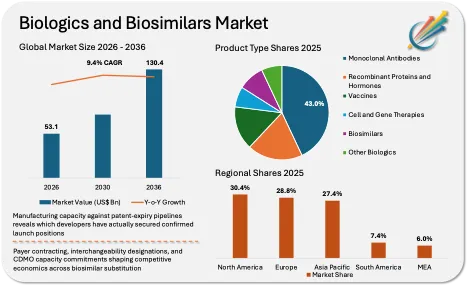
- The global biologics and biosimilars market is projected to reach US$ 531.3 billion in 2026, expanding to US$ 1,304 billion by 2036
- The market is forecast to register a CAGR of 9.4% between 2026 and 2036, among the steeper expansion trajectories in the specialty pharmaceutical category
- Monoclonal antibodies retain dominance in overall category value, but biosimilars are capturing a disproportionate share of new prescription volume as reference products lose exclusivity
- Contract manufacturing capacity reservations now extend 18 to 36 months ahead of launch for tier-one biosimilar developers, effectively rationing access for late entrants
- Oncology and immunology indications account for the majority of contracted biosimilar substitution volume, with chronic and metabolic disorders trailing earlier expectations
- Cell and gene therapy adjacent categories remain commercially smaller but are attracting concentrated strategic capital from developers seeking platform differentiation
- Payer contracting economics are increasingly determined by the credibility of a developer's manufacturing and supply commitments rather than headline discount assumptions
According to Research Manager from Market Minds Advisory, “The biologics and biosimilars market has crossed the threshold from regulatory validation to manufacturing scarcity, and the implications have not been fully absorbed by the payer community. Companies that secure bioreactor capacity and structured supply relationships within the next four to six quarters will set the cost and access benchmarks for the entire next phase of substitution. The window for entering on equivalent terms is measurably narrowing.”
Market Dynamics Shaping the Biologics and Biosimilars Market
Strategic Window Why The Next Four Quarters Will Determine Formulary Position
The competitive geometry of this market is being set right now, in contracting conversations most observers cannot see. Manufacturing relationships, payer formulary terms, and interchangeability designations are the three currencies that will define winners through 2033, and all three are being denominated and distributed today.
- Manufacturing slot allocation is the binding constraint. Tier-one CDMOs are operating with order books that stretch deep into the latter half of the decade. Developers without confirmed slots in the near term will face material cost premiums or delayed launch windows when they eventually enter the queue.
- Payer contracting economics are hardening. The first wave of formulary substitution agreements is being signed at terms that reflect today's competitive landscape. Later entrants will negotiate against benchmarks set by these earlier deals, with limited room to claim equivalent volume or margin protection.
- Interchangeability designations are increasingly non-fungible. Once a biosimilar secures pharmacy-level substitution status in a given market, later entrants targeting the same molecule compete for residual volume on materially weaker terms.
Critical Market Inflection As Manufacturing Commitments Now Precede Regulatory Filing
The traditional sequence of biosimilar development has inverted. In the conventional model, regulatory approval preceded large-scale manufacturing investment. In the current market, confirmed manufacturing capacity has become a precondition for credible launch timelines, because payers and health systems want to see supply certainty before committing to formulary switches. This reordering is reshaping how the entire value chain is structured.
- CDMOs have become gatekeepers, not vendors. The negotiating posture between contract manufacturers and biosimilar developers has shifted noticeably. Allocation decisions now factor in commercial credibility and pipeline breadth, not simply purchase order timing.
- Payer risk assessment is repricing substitution speed. Health systems increasingly differentiate between developers backed by confirmed supply commitments and those relying on speculative launch timelines, and that distinction is becoming a meaningful factor in formulary placement decisions.
- Vertical integration is returning as a strategy. Several large biosimilar developers have moved from arms-length contract manufacturing toward equity stakes or captive production arrangements. This reflects an explicit conclusion that supply security cannot be guaranteed through contracts alone.
Strategic Market Realities That Diverge From Consensus Expectations
A substantial share of announced biosimilar pipelines will not reach commercial launch by 2030. The gap between filed applications, approved products, and commercially launched biosimilars is widening, not narrowing. Manufacturing capacity constraints, patent litigation delays, and payer contracting complexity will eliminate a meaningful portion of the headline pipeline. The strategic question is no longer how many biosimilars are in development, but which candidates actually have the manufacturing and legal conditions to reach the market on schedule.
Insulin biosimilars will lose relative share to next-generation monoclonal antibody and ADC biosimilars faster than current narratives suggest. The dominant industry framing positions insulin as a mature, high-volume biosimilar category. In practice, pricing compression in insulin has already reduced margin incentive for new entrants, while oncology and immunology biosimilars targeting high-cost reference products are attracting the bulk of new development investment. The category growth story is more concentrated than reported.
Interchangeability will matter more than molecular similarity in determining commercial winners through 2033. Early forecasts placed clinical and analytical comparability as the primary competitive differentiator. The actual determinant of commercial success is increasingly which developers secure interchangeability designation first, since pharmacy-level substitution without physician intervention materially expands addressable volume. Comparability will remain necessary, but it will not be sufficient to win share.
Structural Drivers Reshaping Competitive Boundaries Across the Value Chain
Patent Cliff Timing Is Concentrating Development Investment
A concentrated wave of major biologic patent expiries between 2026 and 2030 is channeling biosimilar development investment toward a small number of high-value reference molecules. Biosimilar-preferred procurement policies and mandated formulary review cycles are directing payer demand toward developers that can supply at scale immediately upon patent expiry. The practical consequence is that commercial advantage is being concentrated rather than dispersed across developers. A handful of first-to-market biosimilars now influence a disproportionate share of subsequent payer contracting terms in the same molecule class.
Contract Manufacturing Localization Is Becoming A Procurement Criterion
Domestic manufacturing incentives, embedded in industrial and health policy across the United States, the European Union, India, and South Korea, are reshaping where biosimilar production capacity is being built. Developers without regional manufacturing footprints in priority markets face exclusion from public procurement tenders and government-backed formulary programs. This is producing a wave of regional capacity announcements that goes beyond marketing. Capital allocation decisions are being made now to position for procurement cycles that will run through 2029 and beyond. Companies that delay localization decisions risk being locked out of the largest demand pools entirely.
Chronic Disease Burden Is Creating Durable Captive Demand
Oncology centers, rheumatology practices, and specialty clinics are operating under cost-containment pressure that cannot be resolved through efficiency improvements alone. For these providers, biosimilar adoption has shifted from optional to budget-driven. The shift in prescriber psychology matters. Cost-driven prescribers behave differently than brand-loyal ones. They accept formulary switching more readily, value supply reliability over marginal price differences, and are more receptive to multi-molecule biosimilar contracts. This is changing the qualitative character of the demand base.
Capital Markets Are Differentiating Between Scaled And Speculative Developers
Equity and credit investors have grown more discerning after early biosimilar entrants experienced margin compression faster than projected. Capital is flowing toward developers with proven manufacturing execution, broad molecule pipelines, and established payer relationships, while single-asset developers struggle to attract serious financial backing. This selectivity is healthy for the market but demanding for participants without strong credentials. The companies that built manufacturing and regulatory credibility in early launches now command preferential access to capital, and that advantage compounds with each subsequent molecule.
Risk Assessment Material Headwinds That Could Moderate Substitution Pace
- Patent litigation and settlement delays. Reference product manufacturers continue to use patent thickets and settlement agreements to delay biosimilar entry, and the timing uncertainty this creates complicates manufacturing and launch planning for developers.
- Interchangeability approval variability. Regulatory standards for interchangeability designation differ across major markets, and the resulting inconsistency slows pharmacy-level substitution in some jurisdictions relative to others.
- Physician and patient switching resistance. Prescriber and patient familiarity with reference biologics creates switching hesitancy, particularly in complex or long-duration treatment regimens where continuity is clinically sensitive.
- Manufacturing and analytical capacity constraints. Specialized bioreactor capacity and analytical characterization expertise remain limited, creating scheduling bottlenecks for developers without established infrastructure.
- Reimbursement and pricing policy uncertainty. Bridging mechanisms between payer cost targets and developer margin requirements are still maturing in several markets, and this can delay formulary adoption decisions.
- Geopolitical exposure in raw material and cell-line supply. Specialized cell culture media components, single-use bioprocessing consumables, and certain reagents have concentrated supply geographies that introduce cost and availability risk.
Biologics and Biosimilars Market Segmentation
By Product Type
- Monoclonal Antibodies
- Recombinant Proteins and Hormones
- Vaccines
- Cell and Gene Therapies
- Biosimilars
- Other Biologics
Monoclonal antibodies retain the largest share of category value, reflecting broad clinical application across oncology, immunology, and inflammatory disease. Recombinant proteins remain relevant in established indications such as growth hormone deficiency and clotting disorders. Vaccines and insulin represent large-volume, established categories with mature biosimilar competition in several markets. Cell and gene therapies remain earlier in commercialization but are attracting concentrated strategic interest as a potential next wave of biosimilar-adjacent competition.
By Manufacturing Type
- In-house Manufacturing
- Contract Manufacturing (CDMO)
In-house manufacturing remains common among large, vertically integrated biologics developers with established bioreactor capacity. Contract manufacturing is gaining share among biosimilar developers seeking to enter the market without committing to large fixed-capital facilities, and CDMOs with biologics-specific expertise are increasingly positioned as gatekeepers of new market entry.
By Application
- Oncology
- Immunology and Autoimmune Disease
- Diabetes and Metabolic Disorders
- Infectious Disease
- Rare and Genetic Disorders
Oncology and autoimmune and inflammatory disease applications account for the majority of biosimilar substitution volume, reflecting both high reference product cost and the scale of the affected patient population. Chronic and metabolic disorders, including diabetes, represent a large but increasingly price-competitive category. Blood disorders and growth hormone deficiency remain smaller in volume but offer differentiated margin profiles for specialized developers.
By Distribution Channel
- Hospital Procurement
- Retail and Specialty Pharmacy
- Government and Public Health Tender
- Outcomes-Based Contracting
Hospital pharmacies account for the largest distribution share, reflecting the infusion-based administration of most biologic therapies. Specialty pharmacies are gaining relevance as biosimilar adoption expands into self-administered and home-infusion formats. Retail and online pharmacy channels remain smaller but growing, particularly for biosimilars in insulin and other self-administered categories.
Shape this report around your priorities: https://marketmindsadvisory.com/request-customization/?report_id=63
Regional Market Outlook
Investment Focus Where The Most Defensible Value Is Concentrating
Manufacturing Capacity And Supply Chain Depth
The most defensible value in the current market is held by developers with established, scaled biologics manufacturing capacity in policy-priority geographies. As biosimilar demand outpaces qualified bioreactor supply, operational manufacturing assets command premium economics. Strategic investors are increasingly willing to pay for proven production rather than speculative capacity expansion plans.
Payer Formulary Relationships With Health Systems
Long-duration formulary agreements with creditworthy health systems and pharmacy benefit managers represent the single most valuable asset in biosimilar commercialization today. Developers backed by these agreements attract preferential capital and manufacturing allocation, creating compounding advantages. The relationships being formed now will define which developers scale and which stall.
Integrated Development And Regulatory Capability
Pure-play biosimilar developers face increasing pressure to demonstrate manufacturing and regulatory execution credibility, while integrated developers combining cell-line development, manufacturing, and commercialization capture more of the total value pool. Vertical integration is returning as a deliberate strategy, particularly for large generic and specialty pharmaceutical companies entering the biosimilar value chain.
Specialized Fill-Finish And Analytical Service Models
A growing segment of biosimilar developers wants fill-finish and analytical characterization as a service rather than as an internal capital investment. Companies that build credible, biologics-specific service capability are positioning to capture recurring revenue with defensible margins. This segment is currently underserved relative to its likely scale by 2030.
What This Means for Decision-Makers
For biosimilar developers. The biologics and biosimilars market has moved past the phase where wait-and-see is a defensible strategy. Securing manufacturing capacity, payer formulary positions, and interchangeability designations in the next four to six quarters will define competitive cost and access positions for the next decade. Treating manufacturing capacity as a strategic asset rather than a procurement step is the posture that distinguishes leaders from followers.
For health systems and payers. Hospitals, pharmacy benefit managers, and health insurers face a closing window to lock in favorable formulary terms with credible, scaled biosimilar suppliers. Long-duration substitution agreements signed now establish reference economics that are difficult to replicate later. Internal capability to evaluate developer credibility, structure multi-molecule contracts, and manage formulary transitions is becoming as valuable as the discount itself.
For investors. The investment thesis has matured past pure regulatory-approval speculation. Manufacturing capacity, payer relationship depth, and interchangeability-backed launches now offer clearer risk-return profiles than headline pipeline announcements. Capital deployed into proven execution capability and supply chain depth is structurally advantaged over capital chasing speculative molecule counts.
For reference product manufacturers. The differentiator is no longer patent duration but the credibility of lifecycle-management strategy. Next-generation formulations, combination therapies, and service-based differentiation are the assets that preserve commercial value after exclusivity expiry. Manufacturers without these strategies will find both pricing power and market share increasingly difficult to defend.
Competitive Landscape – Biologics and Biosimilars Market
Recent Market Developments
- In 2026, Fresenius Kabi and Celltrion each launched competing denosumab biosimilars (Conexxence/Bomyntra and Stoboclo/Osenvelt, respectively), referencing Prolia and Xgeva and expanding payer choice in bone health biosimilars
- In January 2026, Samsung Bioepis added six biosimilar candidates to its pipeline, including dupilumab, guselkumab, ixekizumab, vedolizumab, trastuzumab deruxtecan, and ocrelizumab, targeting 20 biosimilars in its portfolio by 2030
- Henlius and Sandoz expanded their biosimilars collaboration to cover up to ten monoclonal antibody and antibody-drug conjugate assets, broadening joint development and commercialization scope
- Samsung Bioepis received a positive European regulatory opinion for its ranibizumab biosimilar BYOOVIZ, alongside a broader wave of denosumab biosimilar launches across Europe
Market is segmented by Product Type (Monoclonal Antibodies, Recombinant Proteins, Vaccines, Insulin, Cell & Gene Therapies), Manufacturing Type (In-house, Contract Manufacturing/CDMO), Application (Oncology, Immunology and Autoimmune Disease, Diabetes and Metabolic Disorders, Infectious Disease, Rare and Genetic Disorders), and Distribution Channel (Hospital Procurement, Retail and Specialty Pharmacy, Government and Public Health Tender, Outcomes-Based Contracting)
Get Access to complete Analysis: https://marketmindsadvisory.com/buy-now/?report_id=63
Trending Reports
- Biostimulants Market
- Cell Therapy Manufacturing Market
- Cell Culture Media Market
- Protein Purification and Isolation Market
- Protein Expression Technology Market
- Difficult-to-Express Proteins Market
- Sterile Injectable CDMO Market
- Advanced Therapeutics Pharmaceutical Outsourcing Market
- Pharmaceutical Filtration Market
Why choose Market Minds Advisory
Market Minds Advisory delivers decision-grade intelligence to executives across machinery, packaging, chemicals, automotive, ICT, food and beverage, consumer goods, and healthcare. We help organizations sharpen market expansion strategies, accelerate share gains, refine brand positioning, and enable account-level growth. Our forecasting integrates primary interviews, proprietary demand models, and continuous market validation, producing the kind of clarity volatile and emerging industries actually require. Backed by over a decade of sector expertise, our research surfaces white space, opportunity gaps, and competitive blind spots, accounting for recent developments and geopolitical risk. We help businesses see the future of their markets.
Contact Us
Market Minds Advisory
1521 Concord Pike, Suite 301
Wilmington, DE 19803
United States
Email: sales@marketmindsadvisory.com
Website: https://marketmindsadvisory.com/




Comments (0)
Login to join the conversation
Login / RegisterNo comments yet. Be the first to comment!