
U.S. Peptide Drug Conjugates Market to Reach USD 5.81 Billion and Europe USD 3.72 Billion by 2035 as Radioligand Expansion, Antigen-Independent Platforms, and Oncology Demand Drive Growth.
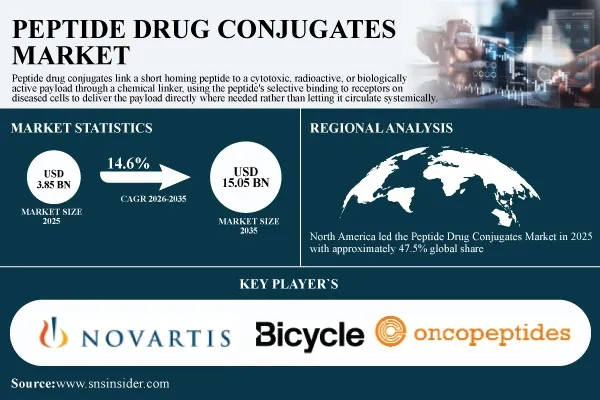
Austin, United States, Sept. 09, 2026 (GLOBE NEWSWIRE) -- According to SNS Insider, The Peptide Drug Conjugates Market was valued at USD 3.85 Billion in 2025 and is expected to reach USD 15.05 Billion by 2035, growing at a CAGR of 14.6% from 2026 to 2035. Peptide-drug conjugates consist of a short “homing” peptide attached to either a toxic, radioactive or bioactive molecule by means of a chemical linker; the selective affinity of the peptide for the diseased cells makes it possible to target the therapeutic compound, thus eliminating the need for systemic distribution. Unlike the antibody-drug conjugate platform, peptides can easily penetrate cancerous tissues, are inexpensive to synthesize and have low immunogenic potential.
Download the Peptide Drug Conjugates Market Sample Report: https://www.snsinsider.com/sample-request/10992
Peptide Drug Conjugates Market Key Highlights
- Market size, 2025: USD 3.85 Billion
- Market forecast, 2035: USD 15.05 Billion
- CAGR: 14.6% from 2026 to 2035
- Largest region: North America, approximately 47.5% share in 2025
- Fastest-growing region: Asia Pacific, approximately 17.8% CAGR
- Largest product type: Radiopharmaceutical PDCs, approximately 41.85% share in 2025
- Fastest-growing product type: Cytotoxic PDCs, approximately 17.35% CAGR
- Largest therapy area: Oncology, approximately 76.92% share in 2025
- Fastest-growing therapy area: Immunology & Autoimmune Diseases, approximately 18.24% CAGR
- Largest route of administration: Intravenous, approximately 63.47% share in 2025
- Fastest-growing route of administration: Subcutaneous, approximately 16.85% CAGR
- Largest end user: Hospitals, approximately 46.28% share in 2025
- Fastest-growing end user: Specialty Clinics, approximately 16.12% CAGR
Market Relevance
The field of Peptide-Drug Conjugates has been emerging as a promising approach to precision medicine, providing an economic and immunogenic alternative to antibody-drug conjugates. Commercial success has largely come from approved radionuclide ligands for treating prostate cancer and neuroendocrine tumors, while cytotoxic and antigen independent conjugates have been steadily progressing into trials for difficult cancers.
Peptide Drug Conjugates Market Overview
The market includes PDC platforms based on radiopharmaceutical, cytotoxic and novel antigen-independent platforms, which are delivered via intravenous and subcutaneous modes. Radiopharmaceutical PDCs have continued to be the most commercially successful by means of radioligand therapy with the targeting of PSMA or somatostatin receptors, both of which have well-defined regulatory and reimbursement pathways, whereas the cytotoxic and receptor-agnostic platforms have shown that a PDC does not need overexpression of tumor receptor for effective cytotoxicity.
Strategic Market Outlook
Growth opportunities exist in extending the applicability of peptide conjugate drugs outside of oncology into the realms of immunology, metabolism, and infectious diseases using established conjugation and linker technologies on less-served indications. The development of antigen-independent and receptor-agnostic PDC platforms offers a second major area of growth, bringing into scope previously unreceptive tumors without an identified overexpressed target for treatment via conjugates.
Metabolic instability and manufacturability issues present challenges. Peptide conjugates are subject to rapid renal degradation and linker instability, an issue highlighted by the removal from the market of the peptide conjugate drug Pepaxto in response to post-marketing safety issues, as well as difficulties associated with sourcing and working with radioisotopes in the context of radioligand PDCs.
Peptide Drug Conjugates Market Regional Analysis
North America had the largest market share of about 47.5% in 2025, attributed to the presence of Novartis’s commercial radioligand platform, experienced developers of clinical-stage PDCs, and a mature pathway for reimbursement of oncology-targeting drugs compared to other regions. The United States had a share of about 85.0% of North America’s revenue. It is home to the most extensive portfolio of approved and late-stage peptide conjugate drug development programs in addition to having a sophisticated radiopharmaceuticals delivery network.
The U.S. Peptide Drug Conjugates Market was valued at approximately USD 1.55 Billion in 2025 and is expected to reach approximately USD 5.81 Billion by 2035, growing at a CAGR of approximately 14.1%.
Europe Peptide Drug Conjugates Market represented around 27.0% share of the global market in 2025, which was valued at USD 1.04 Billion and is projected to grow to USD 3.72 Billion in 2035, registering a CAGR of 13.60% during 2026-2035. The growth is driven by the extensive pharmaceutical production capacity and radioconjugate research collaboration activities in Germany and robust support for biotechnology in terms of government funding. Germany contributed nearly 25.0% of the European revenue in 2025, while the United Kingdom is home to some of the advanced companies developing bicyclic peptide conjugates in the industry.
Asia-Pacific is projected to register the highest CAGR of approximately 17.8% till 2035, on account of growing manufacturing capabilities in biopharmaceuticals, increased government funding for oncology drug development in the region, and presence of huge and underserved patient population base. In 2025, Japan contributed about 33.0% of the revenue in the region, owing to its ecosystem in discovery of peptide macrocycles, while China has growing capabilities in contract development and manufacturing services of the PDC pipelines.
Buy the Peptide Drug Conjugates Market Report with Competitive Analysis and 2035 Forecast: https://www.snsinsider.com/checkout/10992
Peptide Drug Conjugates Market Segment Analysis
By Product Type: The market share of Radiopharmaceutical PDCs is estimated to be about 41.85% in 2025 with commercialization of PSMA and somatostatin receptor-targeted radioligand therapy drugs having regulatory approval and reimbursement mechanisms in place. Cytotoxic PDCs are the highest growing category with the compound annual growth rate of 17.35%. The cytotoxic PDCs are independent of antigens and treat cancers unresponsive to
By Therapy Area: Oncology had market share of about 76.92% in 2025 because this is where all the approved products and most of the pipeline are focused on. The fastest growing therapy area is Immunology & Autoimmune Diseases, having a CAGR of about 18.24%, as advancements in peptide engineering have made it possible to conjugate immunomodulatory payloads to disease specific homing peptides.
By Route of Administration: Intravenous drug delivery held a market share of about 63.47% in 2025 due to the fact that almost all commercially available radiolabeled ligands and cytotoxic PDC drugs required intravenous administration through the infusion center in a controlled environment. Subcutaneous drug administration is the fastest growing method of drug administration with a CAGR of 16.85%., as developers of non-radioactive PDC candidates increasingly design formulations for at-home or outpatient dosing.
By End User: Hospitals had a market share of approximately 46.28%, as they have the ability to handle the radiological safety protocols and intricate adverse event management, which is essential for the current generation of PDC therapies. The Specialty Clinics is the fastest growing market segment at a CAGR of 16.12%, as they develop capabilities for administering PDC therapies beyond a hospital environment.
Peptide Drug Conjugates Market Key Trends
- Radioligand-based PDCs continuing to anchor commercial revenue as Pluvicto's label expands into earlier-stage prostate cancer
- Non-oncology applications diversifying pipelines into inflammatory, metabolic, and infectious disease indications
- Bicyclic and constrained peptide scaffolds gaining traction against historically undruggable targets like EphA2
- Antigen-independent, receptor-agnostic platforms opening tumor types once unaddressable by targeted conjugates
- Pharma-biotech collaborations accelerating pipeline development through radioconjugate partnerships
Major key players include
- Novartis AG
- Bicycle Therapeutics plc
- Cybrexa Therapeutics, Inc.
- Oncopeptides AB
- AstraZeneca plc
- PeptiDream Inc.
- Theratechnologies Inc.
- Avacta Group plc
- Angiochem Inc.
- Soricimed Biopharma Inc.
- WuXi AppTec Co., Ltd. (WuXi STA)
- Bristol-Myers Squibb Company
- Eli Lilly and Company
- Telix Pharmaceuticals Limited
- Curium Pharma
- Ipsen S.A.
- Genentech, Inc. (Roche Group)
- Fusion Pharmaceuticals Inc.
- ITM Isotope Technologies Munich SE
- Sanofi S.A.
Explore the Complete Peptide Drug Conjugates Market Report: https://www.snsinsider.com/reports/peptide-drug-conjugates-market-10992
CONTACT: About Us:
SNS Insider is one of the leading market research and consulting agencies that dominates the market research industry globally. Our company's aim is to give clients the knowledge they require in order to function in changing circumstances. In order to give you current, accurate market data, consumer insights, and opinions so that you can make decisions with confidence, we employ a variety of techniques, including surveys, video talks, and focus groups around the world.

Contact Us:
Rohan Jadhav - Principal Consultant
Phone: +1-315-961-9094 (US)
Email: info@snsinsider.com




Comments (0)
Login to join the conversation
Login / RegisterNo comments yet. Be the first to comment!