
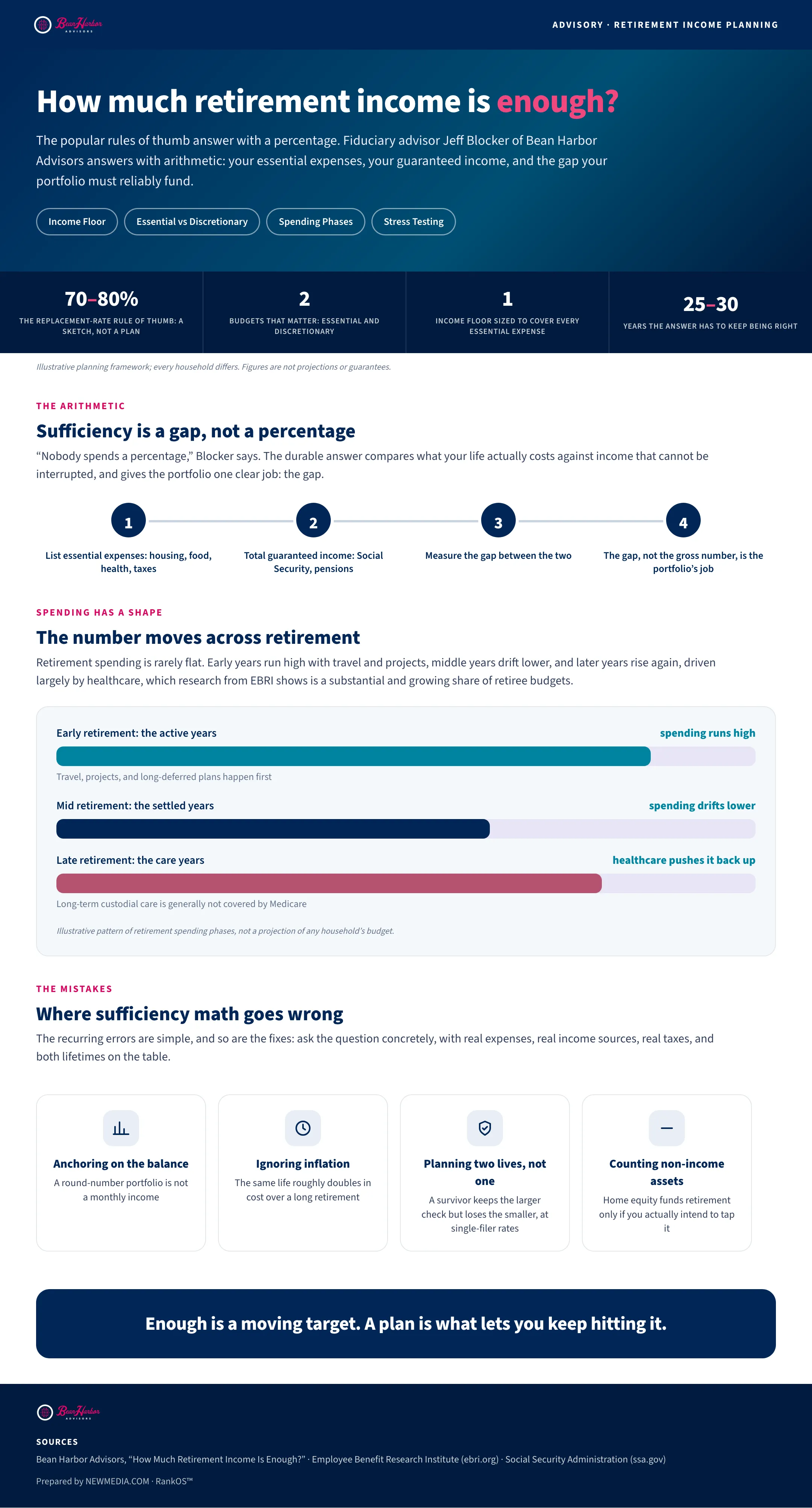
Replacement-rate shortcuts tell retirees what people like them might spend, says fiduciary advisor Jeff Blocker, but a durable answer starts with what their own life actually costs, and which of those costs must never depend on markets.
How Much Retirement Income Is Enough?
BOSTON, MA, Sept. 02, 2026 (GLOBE NEWSWIRE) -- It is the first question nearly every pre-retiree asks, and the one most planning shortcuts answer worst: how much income will be enough?
According to Bean Harbor Advisors Founder and fiduciary financial advisor Jeff Blocker, the popular rules of thumb are useful for a rough orientation and misleading as a plan, because sufficiency is a property of a specific household, not of a percentage.
The best-known shortcut holds that retirees need roughly 70 to 80 percent of pre-retirement income. The estimate has a real basis: commuting, payroll taxes, and retirement contributions end at retirement, so many households genuinely spend less. As a first sketch, it is serviceable. As an answer, Blocker argues, it fails three different ways.
First, it describes averages, and no household is average. Retirees with paid-off homes and modest tastes routinely live well below the range; retirees with ambitious travel plans, dependent family members, or expensive health situations can exceed their working-years spending for a decade. Second, the percentage is anchored to income rather than expenses, so two families earning identically get identical advice despite entirely different lives. Third, it treats retirement as one flat number, when spending in practice has a shape that changes across twenty five or thirty years.
"Nobody spends a percentage," said Jeff Blocker, Founder and Financial Advisor at Bean Harbor Advisors. "They spend a mortgage, a grocery bill, a trip to see the grandkids, a premium, a property tax bill. Until you have looked at those actual numbers, any percentage is a guess wearing a suit."
Start With Two Budgets, Not One
The firm’s planning conversations begin by splitting expected spending into two categories: essential expenses, the housing, food, utilities, insurance, healthcare, and taxes a household must cover in any market, and discretionary expenses, the travel, gifts, hobbies, and generosity that make retirement worth having but can flex in a difficult year.
The split matters because the two categories deserve different funding. Essentials want reliability; discretionary wants flexibility. Collapsing them into a single number hides the most important design decision in retirement income: how large the reliable layer must be.
The Income Floor: Sizing the Layer That Cannot Fail
That reliable layer is often called an income floor: the portion of income arriving from sources that do not depend on markets, such as Social Security, pensions where they exist, and, for some households, income annuities. A widely used design principle holds that the floor should cover essential expenses, so that no bear market can ever threaten the household’s baseline life.
Framed this way, the sufficiency question becomes concrete arithmetic. A household lists essential spending, totals its guaranteed income sources, and examines the gap. The gap, not the gross number, is what the portfolio must reliably produce, and its size drives nearly every downstream decision: how much investment risk is tolerable, how valuable delaying Social Security is, and whether guaranteed income deserves a larger role.
"When a family sees that their essentials are covered no matter what markets do, something changes in the room," Blocker explained. "The portfolio stops being a lifeline and becomes a fund for the good stuff. That psychological shift is worth as much as the arithmetic."
Social Security timing sits at the center of floor design, since it is the rare income source that is inflation adjusted and payable for life. For many households, each year of delayed claiming is effectively the purchase of a larger permanent floor, an interaction the firm examined in its analysis of claiming mistakes.
The Number Moves: Spending Has a Shape
Retirement researchers have long observed that spending is not flat. Early retirement years often run high, as long-deferred travel and projects finally happen. Middle years frequently drift lower as activity naturally slows. Later years can rise again, driven largely by healthcare and support needs.
Healthcare deserves its own line in every projection. Research from organizations such as the Employee Benefit Research Institute consistently shows out-of-pocket health costs are a substantial and rising share of retirement spending, and long-term custodial care, which Medicare generally does not cover, remains the largest unfunded risk in most household plans.
Inflation compounds quietly beneath all of it. At even moderate rates, the cost of the same life roughly doubles across a long retirement, which is why a sufficiency answer that ignores growth in the floor and the budget is an answer with an expiration date.
"The question is never just how much is enough at 65," Blocker said. "It is how much is enough at 75, at 85, at 95, for two people and then perhaps for one. Enough is a moving target, and a plan is what lets you keep hitting it."
The Sufficiency Mistakes Planners See Most
In the firm’s planning conversations, a handful of sufficiency errors recur. Households anchor on portfolio size rather than income, celebrating a round-number balance without ever translating it into the monthly amount it can reliably produce. They project today’s budget forward without inflation, quietly assuming their ninety-year-old selves will live at seventy-year-old prices. They plan for two lives but not for one, overlooking that a surviving spouse typically keeps the larger Social Security check but loses the smaller one, while moving to less favorable single-filer tax brackets.
Some count assets that are not income: a home’s equity funds retirement only if the household actually intends to sell or borrow against it, and business value funds retirement only at the price a buyer will actually pay. Others ignore the tax character of their savings entirely, treating a tax-deferred dollar as equal to a Roth dollar when the spendable difference between them can be substantial.
None of these mistakes requires sophistication to avoid, Blocker notes. They require only that the sufficiency question be asked concretely, with real expenses, real income sources, real taxes, and real time horizons on the table.
From Number to Plan
Once the gap between essential spending and guaranteed income is visible, the remaining design work connects directly to disciplines the firm has examined in earlier analyses: withdrawal policies that flex with markets, tax-efficient sequencing that determines how much gross income the same net spending requires, and Medicare timing that shapes the health-cost line itself.
Taxes are the least intuitive entry on that list. Because withdrawals from different account types are taxed differently, two households with identical spending can need meaningfully different gross incomes. Sufficiency, in other words, is partly a tax question, one more reason the firm treats income planning and tax planning as a single conversation.
Bean Harbor Advisors stress tests each income plan against unattractive scenarios: an early bear market, higher-than-expected inflation, a long life, a surviving spouse living on the smaller of two Social Security checks with single-filer tax brackets. A number that survives those tests, Blocker notes, has earned the word enough.
"As a fiduciary, I cannot hand someone a percentage and call it a plan," Blocker said. "What I can do is help them see their own numbers clearly, cover the essentials with income that cannot be interrupted, and give the rest of their money a job they actually care about."
The firm encourages pre-retirees to run this exercise well before a retirement date is chosen, beginning with a realistic essential budget and current benefit estimates from the Social Security Administration, so the sufficiency question is answered with figures rather than folklore.
The exercise also has a practical byproduct: clarity about work itself. Households that discover a modest gap sometimes realize that one or two additional working years, or a phased retirement with part-time income, closes it entirely, while households that discover a surplus gain permission to retire earlier or give more generously than they had assumed they could. Either discovery is worth far more than a percentage.
As pensions continue to fade and retirements stretch longer, Bean Harbor Advisors expects the industry conversation to keep shifting from accumulation targets toward income sufficiency: not how large the portfolio is, but how reliably it can fund the life a household actually intends to live.
Frequently Asked Questions
How much retirement income do I need?
Rules of thumb suggest 70 to 80 percent of pre-retirement income, but a durable answer starts from your own essential and discretionary expenses, compares essentials against guaranteed income, and funds the remaining gap from the portfolio.
What is a retirement income floor?
It is the layer of income from sources that do not depend on markets, such as Social Security and pensions, sized to cover essential expenses so a market downturn can never threaten the household’s baseline standard of living.
Does spending stay the same throughout retirement?
Generally no. Spending often runs higher in the active early years, drifts lower in the middle, and rises again later with healthcare needs, which is why sufficiency should be modeled across decades rather than as one flat number.
Is 80 percent of my salary enough to retire on?
Sometimes, but the percentage is only an orientation. Households with paid-off homes may need far less; those with big travel plans, dependents, or health costs may need more, and taxes and inflation shift the answer over time.
Key Facts
|
Related Resources
- Bean Harbor Advisors
- Meet the Bean Harbor Advisors team
- Social Security Administration: retirement benefits
- Employee Benefit Research Institute: retirement research
- Investor.gov (SEC): investment products and basics
About Bean Harbor Advisors
Bean Harbor Advisors is an independent fiduciary financial advisory firm dedicated to helping individuals and families prepare for and navigate retirement with confidence. The firm specializes in retirement income planning, Social Security and Medicare guidance, tax-aware retirement strategies, estate planning coordination, and holistic financial planning designed to help clients make informed long-term financial decisions.
For more information please visit: https://beanharbor.com





Comments (0)
Login to join the conversation
Login / RegisterNo comments yet. Be the first to comment!